
'/%3E%3C/svg%3E)
'/%3E%3Cpath%20fill='%23b2b2b2'%20d='M241%20382q0%2016%2017%2026%2017%2011%2042%2011t42-11q16-11%2017-26V269H241'/%3E%3Cpath%20fill='%239f7e00'%20d='M241%20379q0%2014%208%2023%209%209%2021%209%2014%200%2021-9%209-9%209-23V269h-59'/%3E%3Cpath%20d='M241%20339v-70h59v110q0%2014-9%2023l-6%205v-68h-15v72q-8%200-14-4v-68zm59%2040c0%2022%2015%2032%2029%2032%2021%200%2030-18%2030-32v-40h-59'/%3E%3Cpath%20fill='%239f7e00'%20d='M266%20277v5h2v12h-3v-5h2v-5h-9v5h2v5h-4v9h3v18h-5v10h34v-10h-5v-18h3v-9h-4v-5h2v-5h-9v5h2v5h-3v-12h2v-5zm42%20101q0%2010%206%2017%206%206%2015%207%2010-1%2016-7%206-7%206-17v-29h-43'/%3E%3Ccircle%20fill='%230044ad'%20cx='329.5'%20cy='372'%20r='6'/%3E%3Cellipse%20fill='%230044ad'%20cx='300'%20cy='340'%20rx='16'%20ry='21'/%3E%3C/svg%3E)



The illusion of European security: why a Russia-centric narrative obscures the true strategic picture
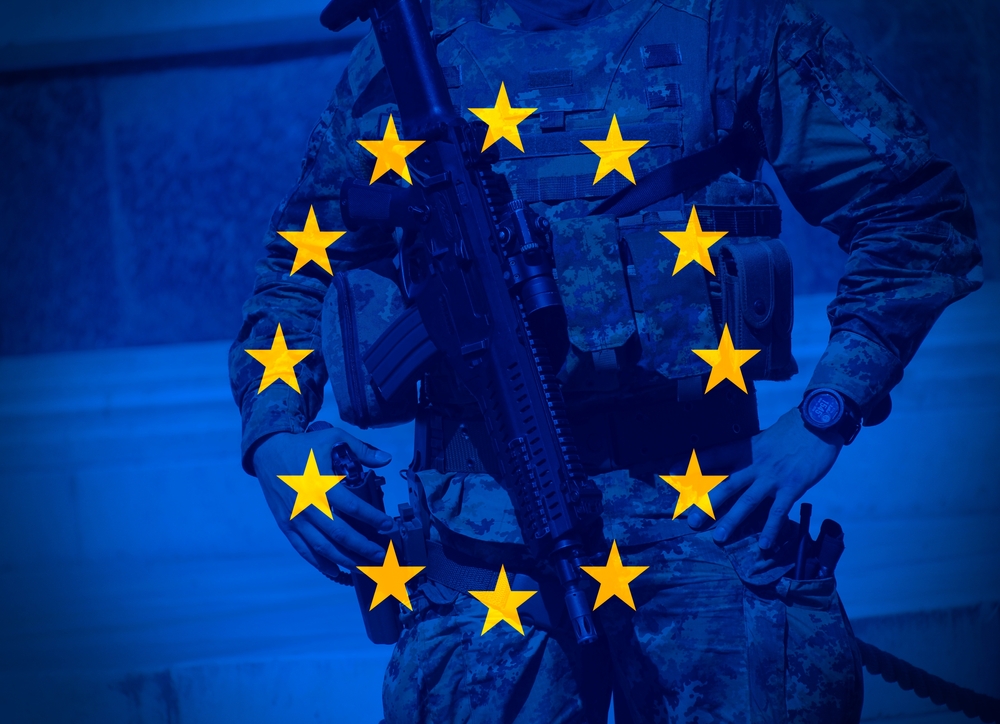
The current assessment of threats in Europe is dangerously incomplete, for whilst Russia poses a significant risk, it is neither the only one nor necessarily the most structural. Whilst the strategic behaviour of the United States, internal European instability and contradictions within the alliance are reshaping the risk landscape such that an approach overly focused on Moscow can lead to strategic errors and makes it essential to develop a credible European security doctrine capable of addressing uncomfortable truths on all fronts.
Europe is undergoing a phase of profound strategic reconfiguration in which the traditional categories of threat and stability are no longer sufficient to describe reality. The prevailing tendency to interpret the security environment in linear terms, identifying a single main adversary and organising the response around it, is proving increasingly limited in a context characterised by the simultaneity of risks, the fragmentation of alliances and the erosion of normative frameworks. European security can no longer be understood solely as a matter of military deterrence against an external actor, but rather as the result of complex interactions between geopolitical factors, internal dynamics and transformations in the international system. In this scenario, analytical simplification not only impoverishes the diagnosis, but also increases the risk of adopting inappropriate strategic responses.
One of the central elements of this new reality is the growing uncertainty surrounding the role of the United States as a guarantor of security in Europe. For decades, the transatlantic architecture was underpinned by the premise of a stable, predictable commitment that was structurally aligned with European interests. However, recent developments in US foreign policy suggest a shift towards a more pragmatic, conditional and, at times, openly transactional approach. This transformation introduces a variable of instability that directly affects the credibility of collective defence mechanisms and the strategic coherence of the Western alliance. The question is no longer whether the United States will remain present in Europe, but under what conditions, with what priorities and under what logic of engagement. This ambiguity constitutes a risk factor that compels a rethinking of the foundations of European security.
At the same time, the continent faces a series of internal vulnerabilities that tend to be underestimated in analyses focused exclusively on external threats. Growing political polarisation, the rise of radical movements, institutional disaffection and socio-economic tensions create an environment in which internal cohesion, an indispensable prerequisite for any effective security strategy, is weakened. These dynamics not only limit the capacity to respond to external crises but can also become vectors of instability.
In a context where political legitimacy and social trust are increasingly fragile, security ceases to be solely a matter of military capabilities and comes to depend on the strength of the political and social fabric. To ignore this dimension is to address the problem from an incomplete perspective.
Finally, the European strategic environment is shaped by a constant interplay of action and reaction that transcends any unilateral narrative. The expansion of security structures, the redistribution of military capabilities, competition between major powers and the gradual disappearance of arms control mechanisms have contributed to shaping a more volatile and less predictable system. In this context, the perception of a threat is as relevant as the threat itself, and the decisions taken by each actor directly influence the responses of the others. The consequence is a security dilemma in which defensive measures can be interpreted as offensive, fuelling cycles of mistrust and escalation. Understanding this logic is essential to avoid simplistic analyses and to move towards a European strategy that not only reacts to risks but can anticipate and manage them with a structural and long-term vision.
The limits of a Russia-centric threat narrative
The dominant discourse on European security increasingly presents Russia as the central and almost exclusive threat to the continent’s stability. This approach, whilst grounded in real events, particularly the invasion of Ukraine, carries a clear risk of oversimplification. Strategic analysis requires not only identifying threats but also contextualising them within broader geopolitical dynamics. An excessive emphasis on Russia can therefore lead to distorted policy responses, particularly when it obscures other equally decisive factors.
Various analytical reports from European agencies provide a clear example of this trend. They place Russia at the centre of a deteriorating European environment, highlighting hybrid warfare, military rearmament and opportunities for escalation. However, these same reports acknowledge, albeit without fully integrating this into their conclusions, that transatlantic cohesion is weakening and that US strategic priorities are shifting away from Europe. This contradiction is fundamental. A fragmented security architecture is not merely a vulnerability that Russia can exploit; it is a structural factor of instability.
A more balanced analysis would start from the recognition that Europe’s current insecurity is the result of a prolonged structural transformation, rather than the action of a single external actor. Since the end of the Cold War, the European security order has been subject to constant reconfiguration. NATO’s expansion, the erosion of arms control agreements and the eastward shift of military infrastructure have contributed to a progressively more tense strategic environment. These factors do not justify Russian behaviour, but they do help to understand the context in which it unfolds.
Ignoring this broader context leads to a self-referential security narrative. In this narrative, Russian behaviour is interpreted exclusively as expansionist aggression, whilst Western actions are regarded as inherently stabilising. This binary framework is analytically weak. It obscures the existence of a reciprocal security dilemma, in which each side perceives the other’s defensive measures as offensive threats. A credible European strategy must move beyond this simplification and recognise that the current risk environment is the result of multiple interactions, including European decisions themselves.
NATO’s expansion and the reconfiguration of European security
NATO’s eastward expansion constitutes one of the most significant developments in post-Cold War Europe. Since 1999, the alliance has incorporated numerous countries in Central and Eastern Europe, culminating recently in the accession of Finland and Sweden. From a Western perspective, this process has been presented as a sovereign decision by states seeking security guarantees. From the Russian perspective, however, it has been perceived as a progressive intrusion into its immediate strategic environment.
This divergence in perceptions is not merely rhetorical. It has concrete material implications. NATO’s infrastructure, including missile defence systems in Romania and Poland, forward deployments of troops and air capabilities, has moved significantly closer to Russia’s borders. These measures are presented as defensive and stabilising, but they also alter the military balance in a way that inevitably influences Moscow’s perception of threat. Strategic stability depends not only on stated intentions, but also on capabilities and their geographical proximity.
The erosion of the arms control regime has intensified these dynamics. The disappearance of key agreements has eliminated essential mechanisms of transparency and limitation. Although these decisions have been justified based on changes in the strategic environment or alleged violations, their cumulative effect has been the creation of a less regulated and more uncertain system. Europe now operates in a strategic environment that is more volatile and less predictable than it was two decades ago.
In this context, portraying Russia as the sole destabilising factor is problematic. The reality is more complex: Europe finds itself within a security system that has evolved through mutually conditioned actions and reactions. NATO’s expansion, the US strategic reorientation and the Russian military response are all part of the same process. Ignoring this interdependence leads to policies that address the symptoms without tackling the structural causes.
The United States as a strategic variable, not a constant
One of the most significant, yet insufficiently analysed, elements of the European risk landscape is the transformation of US strategic behaviour. For decades, Washington has been regarded as the pillar of European security: a predictable guarantor of stability and deterrence. This premise is increasingly being called into question. Recent events point to a shift towards a more transactional and, in certain cases, coercive approach to managing alliances.
Repeated threats to exert pressure on European allies with tariffs, or more recently on Denmark regarding Greenland clearly illustrate this shift. Even if such positions are subsequently moderated, their strategic significance lies in what they reveal: a willingness to put pressure on allied states in the interests of national interests. This calls into question NATO’s founding principle as a community based on shared values and mutual obligations. If security commitments become conditional, the credibility of collective defence is undermined.
Furthermore, the United States’ global priorities are shifting. Strategic competition with China, domestic dynamics and economic considerations are reshaping its foreign policy. Europe is no longer the central axis it was during the Cold War and the post-war period. This transformation introduces a structural uncertainty that cannot be resolved simply through changes in political leadership. The report itself acknowledges that transatlantic divergence reflects a long-term trend.
The implications for Europe are profound. Dependence on a security guarantor whose commitments are increasingly conditional creates systemic vulnerability. In this context, the main risk is not only external aggression, but also strategic over-dependence on an actor whose priorities may diverge substantially. A rigorous analysis must therefore regard the United States as an autonomous variable capable of both strengthening and weakening European security.
Internal European fragilities: the underestimated threat
Whilst external threats dominate the political discourse, Europe’s internal dynamics pose equally significant risks. The rise of far-right political movements, increasing polarisation and the erosion of democratic norms are not marginal phenomena; they constitute structural factors that directly affect the continent’s stability. Security depends not only on military capabilities, but also on political cohesion and social resilience.
Recent developments in various European states highlight this trend. Far-right parties have increased their electoral influence, in some cases participating in governments or exerting decisive influence on the political agenda. Many of these groups are associated with nationalist, Eurosceptic and, in certain cases, openly authoritarian positions. The existence of violent networks linked to these ideologies exacerbates the risk, particularly in contexts of socio-economic discontent.
It is often argued that Russia seeks to exploit these divisions through disinformation and influence campaigns. Whilst this may be partially true, it is essential to recognise that the underlying vulnerabilities are endogenous. External actors may amplify existing tensions, but they do not create them. Focusing the analysis on foreign interference may obscure the internal structural problems that allow such interference to have an impact.
A comprehensive approach to security must, therefore, incorporate these internal dimensions. Political fragmentation, the loss of institutional trust and the normalisation of extremist discourse weaken Europe’s ability to respond to crises. In certain scenarios, these internal dynamics may pose a more immediate threat than external military actions. To ignore them in favour of a Russia-centric narrative is not only incomplete, but strategically risky.
Towards a more realistic European security doctrine
To effectively address its strategic environment, Europe must move away from simplified frameworks and adopt a more nuanced approach. This entails recognising that the continent’s security challenges are multidimensional and interdependent. Russia remains a key actor, but it is not the sole element shaping the system. Shifts in alliances, internal vulnerabilities and global competition among major powers are all part of the same fabric.
The first step is to achieve analytical clarity. Policymakers must avoid binary interpretations, democracy versus authoritarianism, the West versus the East, which oversimplify reality. Such narratives may be useful in political terms, but they are insufficient from a strategic perspective. Effective policy requires an understanding of complexity, including the impact of Western decisions on the overall dynamics.
Secondly, Europe must address its structural dependencies. Reducing reliance on external security providers, particularly the United States, is not an ideological choice but a strategic necessity. This does not imply disengagement, but rather a rebalancing towards greater autonomy. The development of European defence capabilities will be a long and costly process, but essential for reducing vulnerabilities.
Finally, internal resilience must become a central pillar of security policy. This entails strengthening democratic institutions, addressing socio-economic inequalities and countering extremist ideologies. Security cannot be achieved through military means alone; it requires a solid political and social foundation. Without it, even the most advanced defence systems will prove insufficient.
In conclusion, the European risk landscape is considerably more complex than a narrative focused exclusively on Russia suggests. It is shaped by the interplay between external pressures, shifts in alliances and internal dynamics. A credible and sustainable security strategy must reflect this complexity. Otherwise, it risks perpetuating the very vulnerabilities it seeks to address.
Khalil Sayyad Hilario
Founder & CEO, SAHCO Consulting
Madrid, 7 April 2026
Contacter SAHCO
Pour en savoir davantage sur notre expertise et le déroulement de nos missions.


