




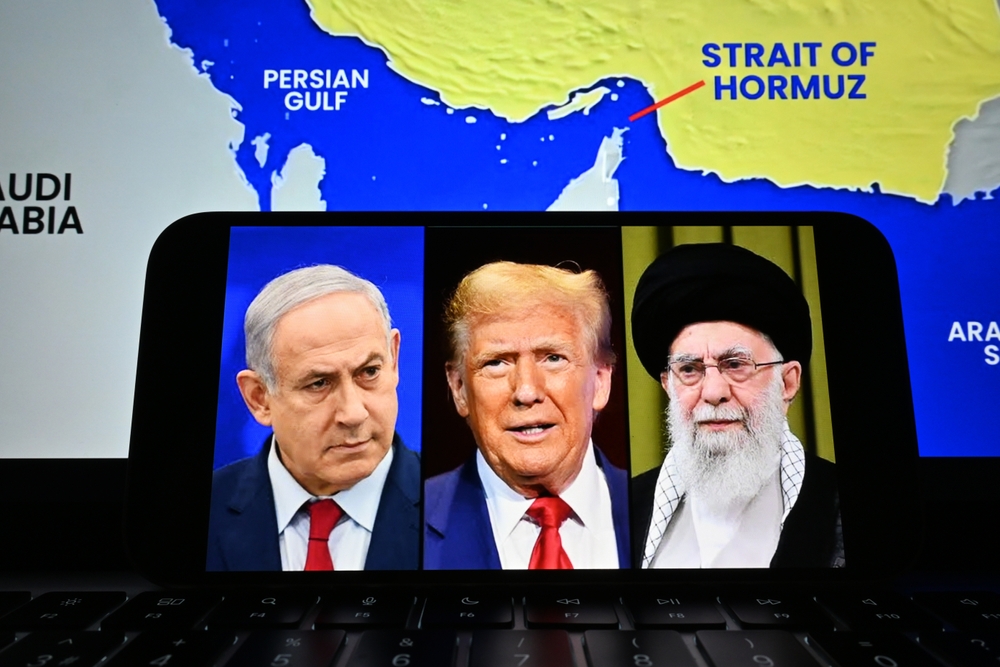
The new war against Iran has been presented as an inevitable response to an imminent threat. But behind this narrative lie questionable strategic assumptions, controversial intelligence, and intense political pressure from Israel on Washington.
In Washington and Jerusalem, the recent military escalation against Iran has been presented as a strategic necessity. Official statements describe the campaign as a defensive action intended to neutralize emerging threats, prevent nuclear escalation, and restore regional stability. The public narrative emphasizes the urgency and inevitability of the decision, suggesting that policymakers had few alternatives.
However, large-scale wars rarely begin for a single reason. They usually emerge from the convergence of strategic interests, political pressures, and geopolitical rivalries accumulated over many years. Public explanations, by contrast, tend to simplify this complexity into a coherent narrative designed to mobilize support and reduce domestic resistance.
Recent developments indicate that the diplomatic and strategic framing of the conflict with Iran has been strongly influenced by close coordination between the United States and Israel, with Israeli leaders actively working to persuade Washington of the urgency of confronting Tehran. Critics argue that the resulting narrative may have exaggerated certain threats while minimizing the risks of escalation. Let us therefore examine whether the main arguments used to justify the war withstand rigorous strategic analysis.
The Security Emergency That Appeared at the Right Moment
The primary justification for the escalation is based on the claim that Iran represented an imminent threat to the United States and its allies. Authorities have repeatedly described the intervention as a preventive response aimed at eliminating emerging dangers before they could materialize. In strategic discourse, this framing transforms a preventive strike into a defensive necessity.
However, the concept of imminence has a precise meaning in international security doctrine. It normally implies a situation in which hostile action is expected in the immediate future and in which delaying a response would significantly increase the danger. Critics argue that the public evidence demonstrating such urgency has been limited.
Several analysts and foreign policy experts have pointed out that there was no public evidence of an immediate Iranian capability to attack the United States directly. In general terms, Iran’s military reach is considered primarily regional, directed at neighboring states and U.S. forces deployed in the Middle East rather than the American mainland.
The Forgotten Lesson of Every War in the Middle East
An effective military strategy usually begins with a clear definition of success. Strategic doctrine highlights three fundamental elements: a precise objective, measurable indicators of progress, and a realistic path to concluding the operation. Without these elements, even limited interventions tend to turn into prolonged and costly conflicts.
In the current campaign, official communication refers to a wide range of objectives. These include weakening Iran’s military capabilities, limiting its nuclear program, dismantling regional allied networks, and deterring future aggression. Each of these objectives constitutes a major strategic challenge in itself.
History offers cautionary examples. U.S. interventions in Iraq and Afghanistan began with relatively limited goals but gradually evolved into prolonged state-building projects. Once military action begins, political pressure and the evolution of events tend to expand the scope of the mission, transforming limited operations into commitments of indefinite duration.
Diplomacy That Looked Suspiciously Like a Performance
Political leaders have stated that diplomatic avenues were explored before the escalation and that negotiations ultimately failed. According to this narrative, Tehran rejected reasonable compromises, leaving military action as the only viable option.
However, diplomacy only succeeds when both sides believe an agreement is possible and when negotiating positions remain relatively consistent. If the conditions for an agreement change repeatedly, the chances of reaching a compromise decrease considerably.
Observers of recent diplomatic exchanges have noted that the agenda of negotiations appeared to shift between different issues, such as nuclear restrictions, missile capabilities, and regional alliances. When negotiating demands span multiple strategic domains at the same time, the process can become unstable. Under such circumstances, diplomacy may become more of a political signal than a genuine mechanism for conflict resolution.
The Convenient Simplification of Instability in the Middle East
Iran’s regional activities are often cited as the primary source of instability in the Middle East. Tehran has supported various armed groups, participated indirectly in several conflicts, and sought to expand its influence in neighboring states. These actions are widely documented and recognized in international analysis.
However, portraying Iran as the main driver of regional instability risks oversimplifying a much more complex geopolitical landscape. The Middle East has experienced overlapping conflicts for decades involving numerous actors, both regional and external.
For example, the U.S. invasion of Iraq in 2003 profoundly altered the regional balance of power and created political vacuums that continue to influence regional dynamics. Likewise, the unresolved conflict between Israel and Palestine remains a central factor shaping alliances, public perceptions, and security calculations throughout the Middle East.
The Recurring Promise That War Will Bring Democracy
Another argument sometimes used to justify intervention is the possibility that weakening Iran’s leadership could create favorable conditions for democratic reforms. The idea that external pressure can catalyze political transformation has frequently appeared in strategic debates over the past two decades.
However, the empirical record of regime-change interventions is mixed. In several cases where governments were overthrown through military action, the subsequent outcome was prolonged political instability rather than democratic consolidation, as seen in Iran in the 1970s, Iraq, Syria, or Libya.
Political transitions depend heavily on internal institutional capacity, social cohesion, and economic stability. External military pressure may accelerate certain political changes, but it can rarely create functioning institutions where none previously existed.
The Dangerous Fantasy of a Manageable Collapse
Another possible outcome of sustained military pressure would be the weakening or even collapse of Iran’s governing institutions. In some strategic debates, this scenario is presented as a way to neutralize a hostile government without undertaking a large-scale occupation.
In practice, the collapse of a state the size of Iran would have profound consequences. Iran has more than eighty million inhabitants and occupies a strategic geographic position connecting the Persian Gulf, Central Asia, and the Eastern Mediterranean.
Institutional disintegration in a country of this scale could generate severe economic disruptions, humanitarian crises, and regional power struggles. The consequences would likely extend far beyond Iran’s borders, affecting energy markets, migration flows, and regional security balances.
Bipartisan Politics and the Elasticity of War Powers
The domestic political dynamics of the United States have also played an important role in the evolution of the conflict. The U.S. Constitution grants Congress the authority to declare war. However, many modern military operations have been carried out through executive decisions rather than formal declarations.
This ambiguity has generated recurring debates about the balance of power between the executive and legislative branches regarding military decisions. Critics argue that bypassing congressional approval weakens democratic accountability in decisions related to war.
Public opinion adds another layer of complexity. Various indications suggest that domestic support for the war has been uneven, with sectors of both parties expressing skepticism about entering another prolonged conflict in the Middle East. The political landscape therefore reflects competing pressures between alliance commitments, security concerns, and societal fatigue with prolonged overseas wars.
Strategic Consequences Yet to Be Revealed
Military conflicts often produce outcomes that diverge significantly from initial expectations. Strategic plans that appear coherent during the planning phase frequently encounter unforeseen realities once operations begin.
The confrontation with Iran illustrates how geopolitical narratives, alliance politics, and internal decision-making interact in military escalation. Israeli leaders have actively portrayed Iran as both a regional and global threat, influencing how the issue has been perceived in Washington. At the same time, critics argue that this framing may have amplified certain risks while minimizing others.
As the conflict evolves, its ultimate consequences will depend not only on developments on the battlefield but also on diplomatic, economic, and political dynamics throughout the region. Wars initiated under conditions of uncertainty rarely remain limited to their initial objectives. The true strategic impact of this one will likely only become fully visible years after the first strikes were ordered.
Khalil Sayyad Hilario
Founder & CEO SAHCO Consulting
Madrid, March 11, 2026
Contacter SAHCO
Pour en savoir davantage sur notre expertise et le déroulement de nos missions.


