



The “Regime Change” Strategy in Iran Ignores the Theological and Cultural Depth of Shiism
The Western doctrine of “regime change” applied to Iran has been built on political assumptions that do not reflect the theocratic nature of the Iranian system. The centrality of clerical leadership and the culture of martyrdom in Shiism create mechanisms of cohesion that challenge classical destabilization logics. By ignoring these deeply rooted religious structures, the elimination of a leader has strengthened (rather than weakened) the legitimacy of the regime.
The assassination of Ayatollah Ali Khamenei on February 28, 2026 has represented one of the most significant geopolitical events in the Middle East in recent decades. The operation, attributed to the United States and Israel, fits within a strategic logic well known in Western military doctrine: eliminating the central leader of a political system with the expectation of provoking its internal destabilization. This strategy assumes that without its dominant figure, the regime will lose cohesion and open the door to political change driven from within society.
However, this calculation appears to have rested on an incomplete understanding of the nature of power in the Islamic Republic of Iran. The Iranian system is not merely a classic authoritarian regime or a personalist dictatorship. It is a political architecture deeply anchored in a specific religious worldview: Twelver Shiism and its conception of clerical leadership as the spiritual and political guide of the community.
Let us examine why the American strategy based on promoting regime change, first by encouraging internal protests and later by betting on the elimination of the Supreme Leader, constitutes a major strategic error. The central hypothesis is that this strategy ignored three fundamental factors: the structural difference between Sunni and Shia Islam, the centrality of martyrdom in Shia political culture, and the moral authority represented by the figure of the ayatollah within the religious hierarchy.
From this perspective, far from provoking the collapse of the Iranian regime, the assassination of Khamenei has produced the opposite effect: strengthening the ideological cohesion of the system, consolidating the narrative of resistance against the West, and amplifying the transnational dimension of Shia religious leadership in the Muslim world.
Sunnis and Shiites: A Historical Divide with Political Consequences
The division between Sunnis and Shiites constitutes the main doctrinal fracture within Islam and continues to shape the geopolitics of the Middle East to this day. This division is not only theological; it also involves profound differences in the conception of political and religious authority within the Muslim community. The origin of this rupture dates back to the year 632, after the death of the Prophet Muhammad. One part of the community believed that leadership should fall to the Prophet’s companions chosen by consensus. From this position emerged Sunni Islam. Another group argued that legitimate leadership should remain within the Prophet’s family, specifically with his cousin and son-in-law Ali. From this interpretation emerged Shiism.
Over the centuries, this initial difference evolved into profoundly distinct religious models. Sunni Islam is characterized by a decentralized religious structure in which no cleric possesses universal authority over the community. In contrast, Shiite Islam developed a much more structured clerical hierarchy in which major religious jurists play a central role in the interpretation of Islamic law.
This difference has decisive political implications. While Sunni Islam generally separates religious power from political power more clearly, Shiism developed a tradition in which religious jurists can exercise direct political authority. The Islamic Republic of Iran is the clearest example of this tradition: a system in which religious leadership lies at the very center of state power.
Martyrdom as a Driver of Political Identity in Shiism
To understand the reaction of the Shia world to the assassination of Khamenei, it is essential to analyze the concept of martyrdom, one of the cultural and religious pillars of Shiism. Unlike other political traditions, the sacrifice of a leader does not necessarily weaken a movement; it can become a powerful catalyst for collective cohesion.
The founding episode of this tradition is the Battle of Karbala in the year 680. In it, Hussein ibn Ali (grandson of the Prophet Muhammad) confronted the Umayyad caliph Yazid and died along with a small group of followers after being surrounded by a vastly superior army. In the Shia narrative, this episode symbolizes moral resistance against tyranny and injustice. Over time, the martyrdom of Hussein became the central axis of Shia identity. Every year, during the Ashura commemoration, millions of believers remember this event through rituals of mourning that recall the sacrifice of the imam. This remembrance is not purely religious; it also transmits a political ethic based on resistance to oppression.
Within this worldview, martyrdom does not represent defeat but a supreme form of moral legitimacy. When a leader dies under circumstances that can be interpreted as a sacrifice for the community, his figure acquires an even greater symbolic dimension. In this cultural context, the elimination of a religious leader can strengthen the ideological narrative of the movement to which he belonged—precisely what has occurred.
Ayatollah Khamenei himself was fully aware of the strong possibility of being assassinated. For years he had publicly referred to the notion of martyrdom and to the idea that his personal life was secondary to the survival of the Islamic Republic. On the day of his death, February 28, he was not sheltered in one of the underground bunkers that formed part of his security system. According to multiple subsequent reports, he was in the office of his official residence in Tehran, together with several members of his family and close advisers, when the complex was struck by the Israeli air attack that ended his life.
This fact reinforces the narrative promoted by the Iranian regime after his death: the image of a religious leader who did not seek protection in an underground shelter but remained in his residence, implicitly accepting the risk of becoming a martyr. Within the Shia worldview, this symbolic dimension is far from minor, as it directly connects with the historical tradition of religious leaders who accept personal sacrifice as the ultimate expression of commitment to the community.
Religious Authority and Political Power in the Figure of the Ayatollah
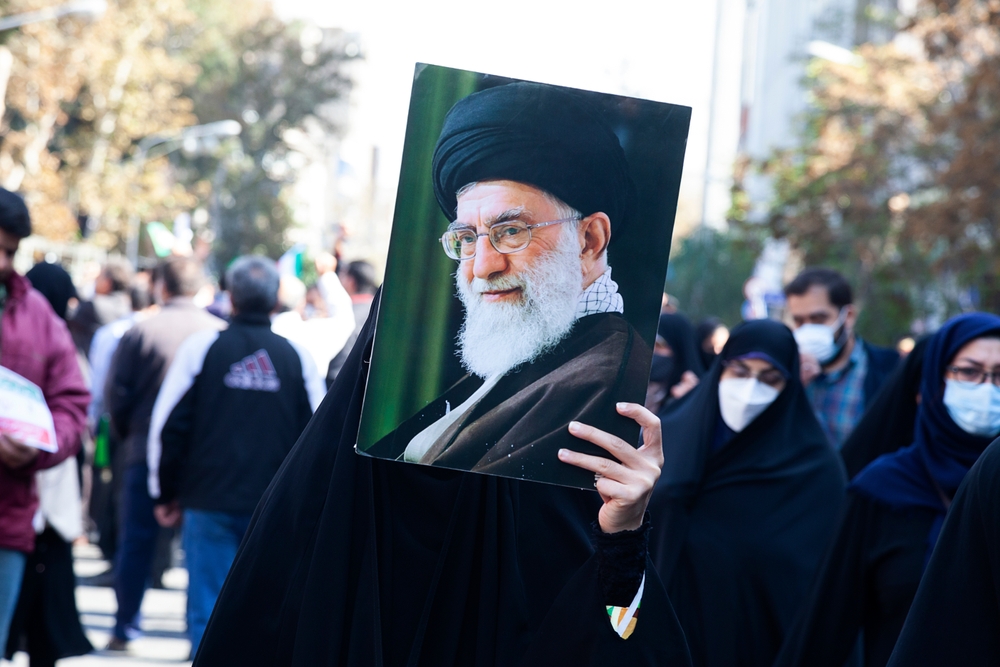
Western understanding of the Iranian system often focuses on its visible political institutions: the president, parliament, or the military apparatus. However, the true core of power lies in the figure of the Supreme Leader, an authority that combines religious, political, and strategic functions in a single office. The title of ayatollah designates an Islamic jurist of the highest rank within Shiism. These clerics have reached the highest level of theological and legal knowledge and are considered spiritual guides for millions of believers. Some of them become global doctrinal references within the Shia world.
In the Iranian system, the Supreme Leader exercises authority that goes far beyond conventional politics. He not only commands the armed forces and defines the country’s major strategic orientations but also represents a source of religious legitimacy. His authority derives both from his institutional position and from his clerical prestige. Ali Khamenei had occupied this position since 1989 and was considered one of the most influential clerics in the Shia world. Only a few religious leaders, including Grand Ayatollah Ali al-Sistani in Najaf, possess comparable authority. His assassination was therefore not perceived merely as the elimination of a political leader, but as an attack on a religious figure of immense significance.
The Impact of Khamenei’s Assassination in Iran and the Shia World
The death of Khamenei has generated a complex reaction both within Iran and in other regions where significant Shia communities exist. Although the country was already marked by internal tensions and criticism of the regime, the assassination of the Supreme Leader has significantly reshaped the political landscape.
Inside Iran, the government has presented his death as an act of external aggression that confirms the regime’s historical narrative: the Islamic Republic as a bastion of resistance against foreign powers. This discourse has allowed the mobilization of sectors of society that, while critical of certain government policies, reject foreign intervention.
At the same time, the institutional apparatus of the state has demonstrated remarkable continuity. The Iranian political system was designed precisely to survive leadership crises through mechanisms of clerical and political succession. The transition toward a new Supreme Leader, Mojtaba Khamenei, son of the late Ali Khamenei, has taken place within this institutional framework.
Beyond Iran, the symbolic impact has been considerable. Shia communities in Iraq, Lebanon, Bahrain, and other parts of the Middle East have reacted with demonstrations of mourning and declarations of solidarity. This reflects the fact that Iranian religious leadership possesses a dimension that transcends the borders of the Iranian state.
The U.S. Regime Change Strategy in Iran Is Based on a Strategic Misdiagnosis
From a strategic perspective, the decision to eliminate the Supreme Leader appears to have rested on a fundamental assumption: that the Iranian regime depends excessively on a central figure and that his disappearance would open the path to a popular uprising and the fall of the regime. This hypothesis draws inspiration from historical cases of the collapse of personalist regimes.
However, the Iranian system does not function solely as a personalist regime. It is a complex ideological and religious structure that possesses institutional mechanisms of continuity. The legitimacy of the system does not depend solely on the leader but on a deeply rooted revolutionary and religious narrative.
Moreover, the logic of martyrdom in Shiism transforms the death of a leader into a powerful instrument of symbolic mobilization. Rather than weakening the regime, the elimination of a central figure has undoubtedly reinforced the perception that the community is under attack and must close ranks around its institutions.
Finally, the transnational dimension of political Shiism implies that such events resonate far beyond Iran. The reaction of Shia communities in different countries demonstrates that Iranian religious leadership forms part of a much broader symbolic network. In this context, a strategy designed to destabilize the regime has ultimately reinforced its legitimacy and expanded its ideological influence.
The Current Scenario
The scenario, as demonstrated by the current situation, is therefore not the immediate collapse of the Iranian regime but rather a phase of internal consolidation accompanied by an intensification of the discourse of resistance. In the short and medium term, it is likely that the Iranian political system will reinforce its internal cohesion, consolidate the succession of clerical leadership, and use the assassination of Khamenei as a central element of its political and religious legitimacy.
In other words, the strategy intended to weaken the regime has ended up strengthening exactly what it sought to destroy. In the context of the political history of Shiism, the strategic risk is clear: eliminating a leader may eliminate a man, but it may also transform him into a symbol. And symbols, in certain political cultures, possess a far more enduring mobilizing power than any individual figure.
Khalil Sayyad Hilario
Founder & CEO SAHCO Consulting
Madrid, March 12, 2026
Contacter SAHCO
Pour en savoir davantage sur notre expertise et le déroulement de nos missions.


