



In degraded or high-risk environments, a team member’s ability to react to a severe injury can be the difference between a contained incident and a critical situation. TECC (Tactical Emergency Casualty Care) training directly addresses this challenge by preparing teams to intervene effectively during medical emergencies occurring under constrained conditions.
However, TECC training is not limited to the acquisition of technical skills. It also relies on the use of a suitable medical kit that is realistic and consistent with real-world intervention settings. Having a minimal kit during exercises strengthens learning, develops the right reflexes, and prevents a dangerous gap between training and real operational conditions.
This article outlines the recommended minimal kit for TECC exercises, its role in team preparedness, and how Sahco Consulting integrates this component into its training programs designed for companies operating in sensitive environments.
Why the Kit Is a Central Component of TECC Training
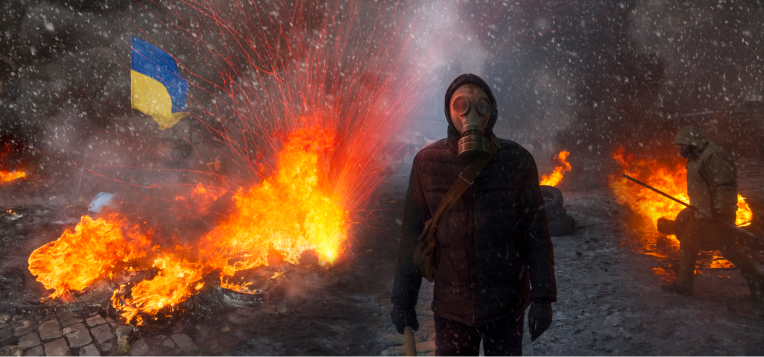
TECC training prepares teams to intervene in medical emergencies while taking into account a potentially unstable context: persistent threat, limited access to emergency services, high stress, and constraints in time and resources.
Within this framework, the medical kit used during exercises plays a key role. It allows participants to familiarize themselves with equipment that is actually available in the field, learn to prioritize interventions, and build automatic responses. An unsuitable or overly theoretical kit significantly reduces training effectiveness and may create a false sense of security.
At Sahco Consulting, equipment selection follows a pragmatic logic: the kit used in training must be simple, realistic, and directly transferable to participants’ professional environments.
Principles of a Minimal TECC Kit for Exercises
A TECC kit designed for exercises is not meant to replicate a full medical setup. Its primary purpose is to enable practice of life-saving priorities under conditions close to those encountered in real operational environments.
The first principle is consistency with the intervention context. Selected equipment must match the teams’ exposure level, their working environment, and their real capacity to transport and use the material.
The second principle is ease of use. Under stress, complexity becomes a risk factor. The minimal kit must therefore include durable, intuitive, and proven equipment that supports rapid operational use.
Finally, the kit must be considered a learning tool, enabling participants to repeat essential techniques and understand the limitations of the equipment available to them.
Essential Components of the Minimal TECC Kit for Exercises
During TECC training, emphasis is placed on addressing the main causes of preventable death in traumatic situations. The recommended minimal kit covers these priorities without overloading participants with unnecessary equipment.
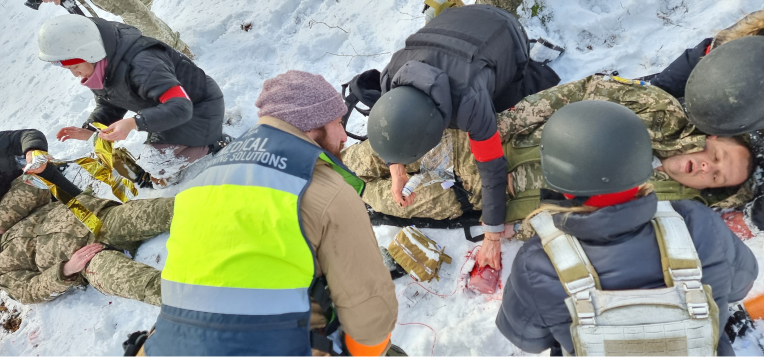
Hemorrhage control is central to the process. Exercises rely on the use of tactical tourniquets and compression dressings in order to teach rapid control of massive bleeding, often the primary cause of death in traumatic environments.
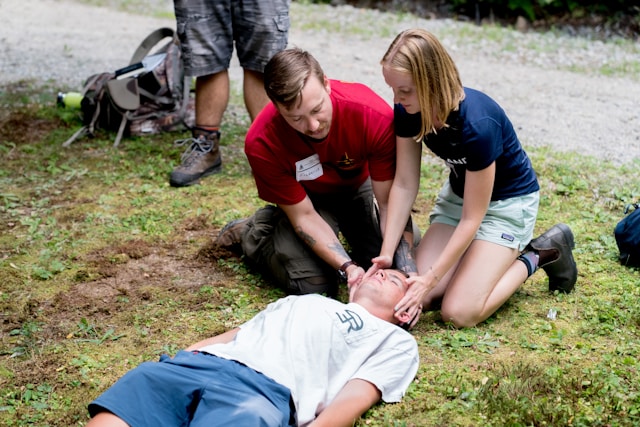
Airway management is also addressed through simple devices, allowing participants to practice airway clearance and maintenance without entering advanced medical procedures inappropriate for field conditions.
Hypothermia prevention, often underestimated, is an integral part of the kit. Thermal blankets and heat-retention solutions reinforce the principle that even in warm environments, heat loss can worsen a casualty’s condition.
Finally, the kit includes personal protective equipment, essential for securing the intervention and preventing risk to the responder.
The objective is not to accumulate equipment but to ensure that teams master a limited number of tools that are genuinely usable in degraded situations.
Adapting the Kit to Exercises and Participant Profiles
A TECC kit cannot be standardized without careful consideration. Needs differ depending on whether the training targets industrial teams, international travellers, operational managers, or field staff exposed to hostile environments.
This is why Sahco Consulting systematically adapts exercise content and equipment to the realities of the supported organizations. Such adaptation ensures relevance, credibility, and stronger engagement from participants.
In certain contexts, the minimal kit may also serve as a foundation for more comprehensive individual or collective kits, later integrated into the company’s safety and crisis-management systems.
The Role of the Kit in Overall Team Preparedness
The TECC kit should not be seen as a mere training accessory. It is part of a broader preparedness approach, alongside procedures, contingency plans, and hostile-environment training.
Used in realistic exercises, it exposes teams to their own limitations, tests their ability to act under pressure, and strengthens coordination between colleagues. It also contributes to building a shared safety culture, an essential asset in risk-exposed environments.
This integrated approach is at the core of Sahco Consulting’s training programs, particularly through the HEAT C-TECC training, which combines hostile-environment preparation with medical emergency management.
Practical Use Cases in Companies
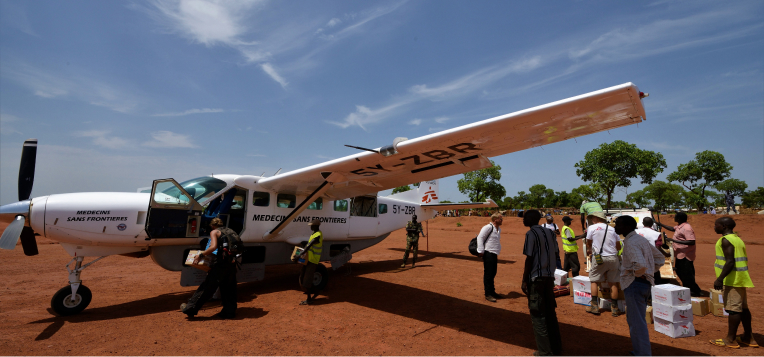
An industrial company operating on remote sites may use TECC training and the associated minimal kit to prepare its teams for life-saving interventions while awaiting external emergency services. This preparation significantly reduces risks related to response delays.
Likewise, a company frequently sending staff abroad may integrate TECC training into its security framework, equipping personnel with kits adapted to travel and local constraints.
In these situations, coherence between training, equipment, and procedures makes all the difference.
FAQ – TECC Training and Minimal Kit
Why use a specific kit during TECC exercises?
Because it enables realistic conditions and develops automatic responses that can be directly applied in the field.
Is the minimal kit sufficient in a real situation?
It is an essential base for the first critical minutes while awaiting more advanced medical support.
Is the kit content identical for all companies?
No. It must be adapted to the risk level, environment, and capacities of the concerned teams.
Does the TECC kit replace full training?
No. It is an essential training support but cannot replace the acquisition of skills and procedures.
Contacter SAHCO
Pour en savoir davantage sur notre expertise et le déroulement de nos missions.


