



TECC Training: content, duration, objectives – everything you need to know

TECC (Tactical Emergency Casualty Care) training addresses a critical need in hostile environments. Designed to prepare humanitarian personnel for high-risk situations, it is based on medical protocols adapted to tactical contexts. This approach is now internationally recognized. It targets professionals exposed to extreme emergencies, particularly in hostile settings.
SAHCO, an expert in post-crisis management, plays a key role in the design and implementation of targeted TECC training programs tailored to the specific needs of field actors.
What is TECC training?
Definition and principles of Tactical Emergency Casualty Care
TECC is based on medical care delivered in hostile environments. Priority actions are determined by the level of threat. The objective is to stabilize casualties until definitive medical care becomes available. This requires adapting to field constraints while applying validated protocols. The approach is inspired by the military TCCC (Tactical Combat Casualty Care) model, while adapting it to civilian and humanitarian missions. It integrates medical, logistical, and stress-management skills.
Differences from other tactical first aid training programs
Unlike conventional training, TECC is not limited to learning basic life-saving gestures. It takes operational dynamics into account. Participants must be able to act under pressure, sometimes without adequate medication or equipment. TECC therefore targets individuals who may be required to intervene before professional medical services arrive. It demands autonomous decision-making in situations of partial or total chaos.
Want to understand why NGOs and humanitarian organizations are adopting TECC? Discover why this training is essential for their critical missions here.
Main objectives of TECC training
Strengthening response capacity in critical situations
Humanitarian personnel must be equipped with skills adapted to field realities. Every second counts. It is essential to know how to prioritize, stabilize, and coordinate. Trainees must be able to intervene quickly without exposing themselves unnecessarily. They must also anticipate complications and act even in the absence of physicians.
Standardizing emergency care protocols
TECC establishes a common operational reference. Everyone applies the same actions, in the same sequence. This facilitates inter-agency coordination. TECC protocols aim to reduce preventable mortality by optimizing the survival chain.
Contact our consulting team to discuss the implementation of emergency care protocols tailored to your operations.
Educational content of TECC training
Theoretical modules on care in hostile environments
The theoretical modules cover the fundamentals of medical care in hostile contexts, including:
- Recognition and immediate management of massive hemorrhage.
- Assessment of airways and response to critical obstructions.
- Hemorrhage control through appropriate treatment.
- Integration of logistical and security constraints into decision-making.
- Use of tactical communication in emergency situations.
- Basic rules to ensure effective personal protection.
These lessons provide the essential foundations for coherent intervention in unstable environments.
Practical exercises and realistic simulations
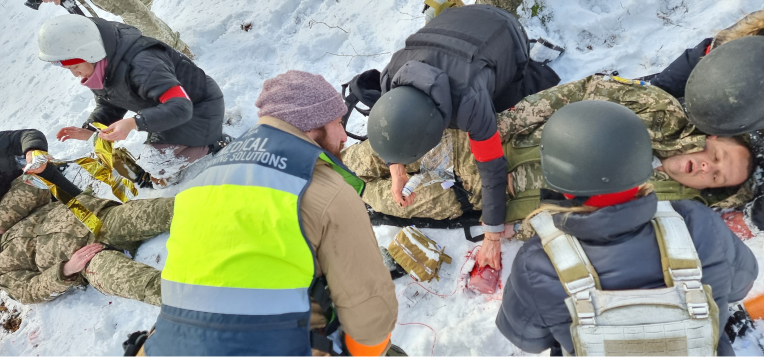
Immersive scenarios are used to test reflexes. Trainees must act quickly in simulated dangerous environments. These exercises are designed to reinforce automatic responses. Continuous training is required to ensure rapid, hesitation-free reactions regardless of context.
To organize a session tailored to your organization, explore our TECC training program.
Duration and organizational formats
Short, intensive, or modular formats
TECC training adapts to participants’ constraints and needs through various formats:
- Flexible duration: training lasts from 2 to 5 days depending on objectives and desired level.
- Intensive course: a condensed option for rapid and comprehensive skill development.
- Modular sessions: spaced modules allowing gradual knowledge integration.
- Adaptability: modular formats suited to busy professional schedules.
These options allow organizations to choose the most appropriate structure for their operational context.
Session organization and participant prerequisites
Participants must be physically fit and willing to operate under stress. No prior medical training is required. However, individuals with experience in unstable environments may assimilate the modules more quickly.
To design a session fully aligned with your objectives and availability, contact our TECC training specialists.
Target audiences for TECC training
Security professionals and law enforcement
Law enforcement officers are often first responders on scene. They must be able to act before medical teams arrive. TECC provides them with practical tools to ensure victim survival and their own safety.
Medical personnel and humanitarian actors
In conflict zones, healthcare professionals may be required to intervene without support. Medical care must be adapted to security constraints. TECC enhances effectiveness by integrating tactical considerations into medical practice.
Assessment and validation of skills
Theoretical and practical evaluation methods
Each trainee is assessed on protocol comprehension and scenario responsiveness. Participants must master the techniques and justify each decision. This dual evaluation ensures true operational readiness in unstable environments.
Certification and international recognition
TECC certifications are recognized by multiple countries and organizations. They open access to sensitive operational missions.
Maintaining TECC training competencies
Regular refresher programs
Skills must be updated. Procedures evolve and contexts change. Frequent refreshers are essential. These sessions ensure alignment with best practices and reinforce decision-making and intervention reflexes.
Additional field-based training
Knowledge must become instinctive. Training under realistic conditions is essential. SAHCO offers tactical refresher modules and advanced assessments. These programs strengthen both physical and mental preparedness over the long term.
To ensure the sustainability of your teams’ TECC competencies, discover our continuous training services tailored to your needs.
Conclusion
TECC training has become a critical lever for responding to tactical emergency situations. It enables humanitarian personnel to act quickly and methodically in unstable environments. Through adapted pedagogy, participants acquire life-saving reflexes and effective coordination skills. In the face of growing crises, targeted, validated, and recognized preparation is essential. SAHCO supports institutions and organizations in implementing programs tailored to their operational realities.
To initiate collaboration or schedule a TECC training session, contact the SAHCO expert team directly.
Contacter SAHCO
Pour en savoir davantage sur notre expertise et le déroulement de nos missions.


