



HEAT Training: Individual Equipment Checklist Before Deployment to High-Risk Areas

Deploying to a high-risk area is not something that can be improvised. For companies whose personnel operate in unstable or degraded environments, individual preparedness is a critical safety factor. Beyond procedures and risk management plans, personal equipment plays a central role in a team member’s ability to cope with a critical situation.
HEAT (Hostile Environment Awareness Training) is designed precisely to prepare teams to operate in hostile environments by developing their understanding of the context, their security reflexes, and their capacity to adapt. In this framework, defining an individual equipment checklist before deployment is a key element of preparation. It helps avoid omissions, standardize practices, and reduce exposure to risks during the first phases of a mission.
This article provides a structured overview of the recommended individual equipment within the context of HEAT training, aligned with Sahco Consulting’s operational approach.
Why Individual Equipment Is a Major Issue in High-Risk Areas
In hostile environments, individual equipment is not about comfort, it constitutes a first line of protection against security, health, and logistical risks. Inadequate or incomplete equipment can rapidly worsen an already degraded situation by limiting mobility, communication, or reaction capability.
HEAT training emphasizes this point: having the right equipment, knowing how to use it, and understanding its limitations are integral parts of preparation. The objective is not to turn staff into survival specialists, but to allow them to operate more safely, autonomously, and rationally in constrained contexts.
Principles of an Effective HEAT Checklist
An individual equipment checklist must adhere to several essential principles. First, it must be adapted to the actual mission context: geographic area, climate, risk level, duration of the deployment, and local support capacity. A standardized approach without contextualization risks creating a gap between preparation and field reality.
The checklist must also remain realistic and transportable. In high-risk areas, mobility is often a key safety factor. Equipment that is too heavy or overly complex quickly becomes counterproductive.
Finally, equipment must be mastered. HEAT training allows participants to test and use gear in scenarios close to reality to avoid unpleasant surprises once on the ground.
Essential Categories of Individual Equipment Before Deployment
Rather than providing an exhaustive list, HEAT training promotes a category-based approach, allowing companies to adapt the checklist to their specific needs.
Communication and Tracking Equipment
The ability to communicate and be located is a fundamental component of personal safety. Reliable communication tools, fallback solutions in case of local network failures, and tracking devices ensure that contact with the organization is maintained and that response is possible in case of an incident.
Individual Medical Equipment
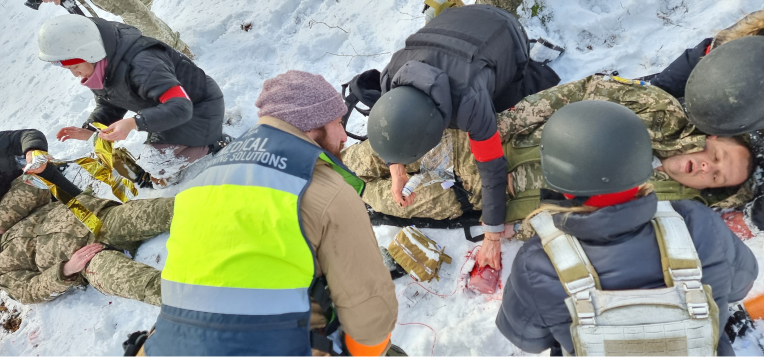
Even without advanced medical skills, possessing basic first-aid equipment is essential. HEAT training highlights that the first minutes after an incident are often decisive. This equipment must correspond to the level of training of personnel and may be complemented, when relevant, by dedicated TECC training.
Personal Protective Equipment
Depending on the context, certain equipment is intended to reduce exposure to environmental or security risks: protection against extreme weather, visibility or discretion depending on the situation, and durability of gear. The objective is to adapt the equipment to the environment without drawing unnecessary attention.
Administrative and Personal Resilience Elements
Essential documents, means of payment, basic self-sufficiency items, and elements allowing personnel to cope with temporary immobilization are integral parts of individual preparation. Lack of these can significantly complicate crisis management.
Adapting the Checklist to Personnel Profiles
Not all teams are exposed in the same way. A staff member on occasional travel, an operational manager, or a permanently deployed field team will not have the same needs. Therefore, the individual equipment checklist must be adapted to different profiles and exposure levels.
At Sahco Consulting, this adaptation is an integral part of HEAT training. Participants learn not only what they must take with them, but also why, and within what limits. This understanding reinforces autonomy and individual responsibility, two critical factors in hostile environments.
Equipment as a Pedagogical Tool in HEAT Training
The equipment checklist should not be seen as a simple logistical document. Within HEAT training, it becomes a pedagogical tool in its own right. Exercises expose participants to realistic situations in which available equipment directly influences decisions and behaviors.
This approach highlights gaps between expectations and reality, fostering more pragmatic preparation. It also enables adjustments to be made before actual deployment.
The HEAT C-TECC training offered by Sahco Consulting fully integrates this dimension, combining hostile environment preparation and medical emergency management.
Practical Applications in Corporate Contexts
An industrial company sending teams to remote sites may use a HEAT equipment checklist to harmonize preparation and reduce individual discrepancies.
Similarly, a service company operating internationally may use this checklist as a discussion baseline before each mission, adapting it to local contexts and identified risk levels.
In such cases, the checklist becomes a mechanism for structured dialogue between teams, management, and security functions.
FAQ – HEAT Training and Individual Equipment
Is the HEAT checklist identical for all high-risk areas?
No. It must be adapted to geography, risk level, and mission type.
Is individual equipment sufficient to ensure safety?
No. It complements procedures, training, and collective systems but does not replace them.
Should personnel be trained to use their equipment?
Yes. Poorly understood equipment can become ineffective or even dangerous.
Is the checklist provided during HEAT training?
It is developed and adapted during the training based on the needs of the company.
Contacter SAHCO
Pour en savoir davantage sur notre expertise et le déroulement de nos missions.


