




False flag operations and manipulation of responsibility in modern geopolitics
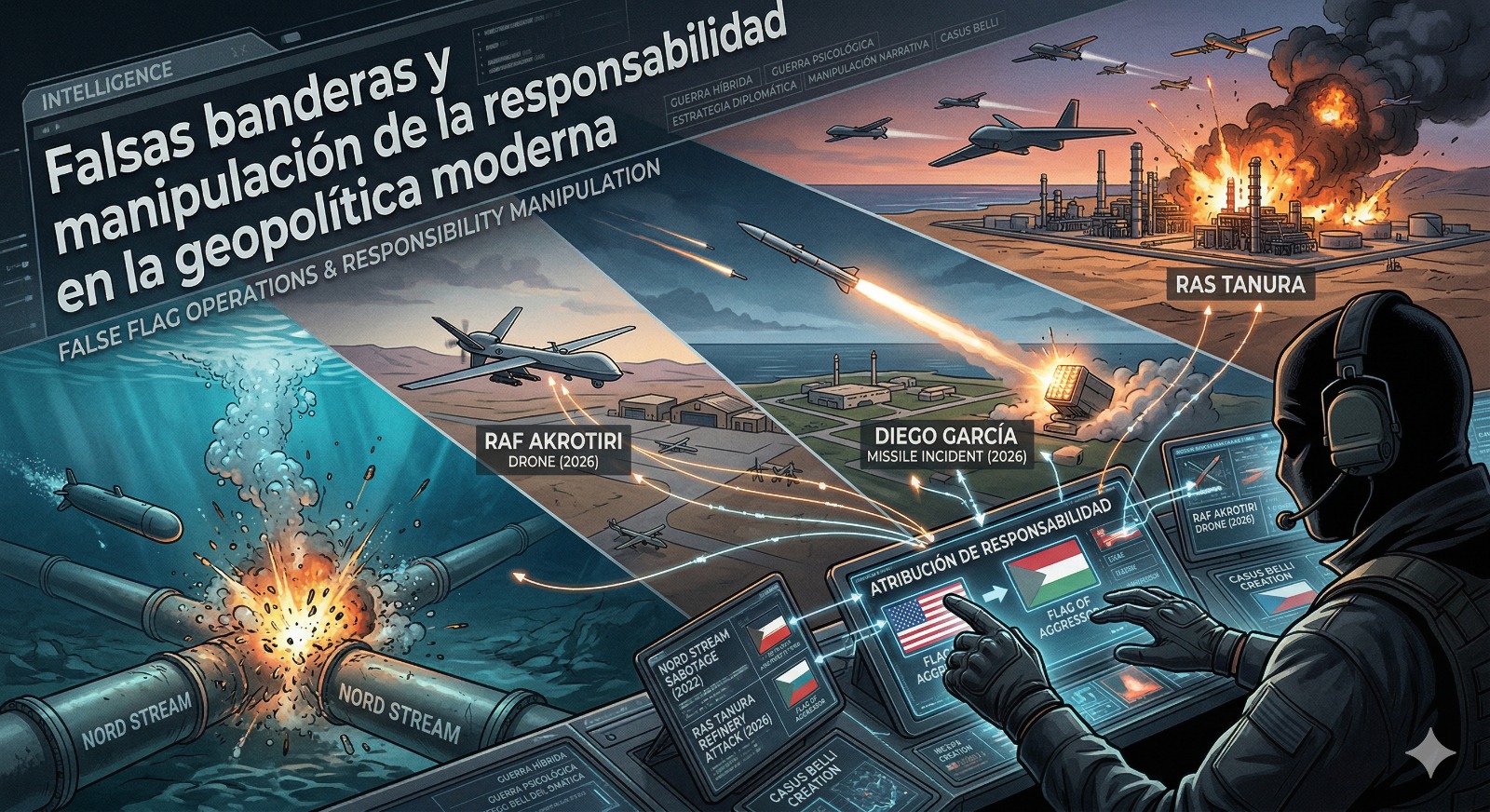
From documented covert operations to recent attacks whose attribution remains disputed, accusations of false flag operations are an increasing part of contemporary conflict. Sabotage of energy infrastructure, military incidents, and drone attacks illustrate how the attribution of violence can become a strategic weapon. In a context of tensions between Iran, the United States, Israel, and their allies, the narrative about who is responsible for an attack can be as influential as the event itself.
In strategic and intelligence analysis, a false flag operation is defined as a covert action, often conducted by intelligence services, designed to appear as if it were carried out by an actor different from the real perpetrator. The term originates from naval warfare, where ships temporarily used an enemy’s flag to deceive opponents. In the contemporary geopolitical context, the concept has expanded to include sabotage, military provocations, attacks, and structured information operations aimed at concealing the real authorship of an attack and directing responsibility toward a third party.
The strategic relevance of these operations lies less in the material damage they cause than in the political impact derived from the attribution of the attack. When an incident is perceived as the work of an adversary, it can trigger political and social reactions that facilitate retaliation, military escalation, or major diplomatic decisions. Precisely because of their deceptive nature, identifying a false flag operation requires particularly rigorous standards of evidence. For this reason, specialized analysis distinguishes between documented operations, plans that were never executed, disputed historical incidents, and contemporary episodes whose attribution remains debated. This distinction is essential to separate rigorous analysis from speculation.
Strategic purpose and political logic
False flag operations function primarily as instruments of narrative manipulation. Their objective is to influence the political interpretation of responsibility for a decisive event. In this sense, they lie at the intersection of intelligence operations, psychological warfare, and diplomatic strategy.
One of the most common objectives is the creation of a casus belli, that is, a political justification to initiate or expand a military action. If an attack appears to have been carried out by an adversary, governments may obtain domestic and international support for a military response that might otherwise face political resistance.
Another purpose is to influence alliances and international perception. Portraying a rival state as aggressive or destabilizing can push neutral or allied countries to adopt a more confrontational stance. In contemporary conflicts, where alliances and public opinion play a decisive role, the perception of responsibility for an attack can be as influential as the attack itself.
A confirmed case in Israel: the Lavon Affair (1954)
One of the most clearly documented examples of a false flag operation linked to Israel is the Lavon Affair, also known as “Operation Susannah,” carried out in Egypt in 1954. Israeli military intelligence organized a clandestine network composed largely of Egyptian Jews tasked with placing explosives in locations associated with British and American interests, such as cinemas, libraries, and cultural centers.
The devices were designed to detonate after closing hours, with the aim of causing few or no casualties, but creating the appearance of a wave of attacks against Western institutions. The intention was to attribute these actions to Egyptian nationalist groups or communist organizations, thereby weakening international confidence in the Egyptian government.
The broader strategic objective was to influence British policy regarding the withdrawal of troops from the Suez Canal. The plan failed when one of the explosives detonated prematurely, resulting in the death of four Egyptian Jews involved and recruited by the Mossad, which helped Egyptian authorities dismantle the network. The public trials initiated in December 1954 revealed the true origin of the operation and triggered a major political crisis in Israel, making the Lavon Affair one of the few documented examples of false flag operations in modern history.
U.S. strategic planning: Operation Northwoods (1962)
Although the United States is not associated with a confirmed modern false flag operation comparable to the Lavon Affair, declassified Cold War documents show that U.S. military strategists considered such tactics. A significant example is Operation Northwoods, a series of proposals developed in 1962 by the Joint Chiefs of Staff during a period of high tension between Washington and Cuba.
The proposals included various deceptive actions aimed at generating public support for a military intervention against the Cuban government. Among the ideas were staged incidents or fabricated attacks that could be attributed to Cuban authorities.
President John F. Kennedy rejected the plan, and it was never carried out. However, the existence of Operation Northwoods demonstrates that the strategic logic of covert provocations was considered within military planning circles during the Cold War.
The USS Liberty incident (June 8, 1967)
Another episode frequently mentioned in debates involving Israel and the United States is the attack on the USS Liberty on June 8, 1967, during the Six-Day War. Israeli aircraft and naval forces attacked the U.S. intelligence ship in the eastern Mediterranean. The attack killed thirty-four American crew members and injured more than one hundred seventy. Official investigations conducted by both Israel and the United States concluded that the incident resulted from a misidentification under combat conditions, with the ship being mistaken for an Egyptian vessel.
Despite these conclusions, the incident has remained controversial for decades. Some crew survivors stated that the ship was clearly marked, with a visible U.S. flag. Among them, Lieutenant Commander David Lewis publicly stated that, in his opinion, Israeli forces knew with certainty that it was a U.S. ship at the time of the attack. These statements have fueled historical debate about what occurred.
From an analytical perspective, some commentators have suggested that, if deliberate, the attack might have aimed to prevent the interception of sensitive communications by the United States or to limit international visibility over certain ongoing military operations on the Egyptian front. Other interpretations have suggested that a large-scale incident could have generated political pressure in Washington for greater direct involvement in the regional conflict. However, these hypotheses have not been confirmed by official investigations. To date, no official inquiry has concluded that the incident constituted a false flag operation, and it continues to be analyzed as a complex case within the context of wartime military operations.
The Nord Stream pipeline explosions (September 26, 2022)
On September 26, 2022, several underwater explosions severely damaged the Nord Stream gas pipelines, which transported natural gas from Russia to Germany through the Baltic Sea. The detonations occurred in waters near the exclusive economic zones of Denmark and Sweden, causing large gas leaks visible on the sea surface. The incident took place amid heightened geopolitical tensions following Russia’s invasion of Ukraine earlier that year and triggered immediate international concern over the security of underwater energy infrastructure.
Authorities in Germany, Sweden, and Denmark launched technical investigations that concluded the damage resulted from deliberate sabotage using explosives placed on the infrastructure. Seismic assessments and underwater inspections indicated that the explosions had been precisely executed at multiple points along the pipelines.
Given the level of planning and technical capabilities required to carry out such an operation in deep waters, many analysts considered it likely that those responsible had access to advanced resources, leading to speculation about the involvement of state actors or groups supported by states. The attribution of the sabotage remains the subject of international debate, although some analyses point toward U.S. intelligence services (CIA). Various analysts have noted that, in geopolitical terms, the destruction of the infrastructure potentially benefited several actors by permanently disrupting the direct supply of Russian gas to Germany and accelerating the reconfiguration of the European energy market.
In public debate, different hypotheses involving various countries or operational groups have been مطرح, each based on possible strategic motivations. However, to date, official investigations have not publicly attributed responsibility to a specific actor, and the episode remains one of the most controversial cases of energy sabotage in contemporary geopolitics.
The attack on the Saudi refinery during the Iran–U.S./Israel conflict (March 2, 2026)
During the military escalation between Iran, the United States, and Israel, which began with strikes against Iranian targets on February 28, 2026, energy infrastructure in the Persian Gulf quickly became part of the conflict. On March 2, 2026, several drones attacked the Ras Tanura refinery in Saudi Arabia, one of the most important oil facilities in the world and a critical node in the global energy system.
The attack caused fires and forced a temporary suspension of operations at the refinery. Initial assessments by regional authorities and several international media outlets indicated that the drones used could be of Iranian origin or derived from Iranian technology. At the same time, U.S. Senator Lindsey Graham, known for his close alignment with President Donald Trump, engaged in intense political and media activity in Washington, making public statements calling for a firm response against Iran and urging Saudi Arabia to actively participate in military efforts against Tehran.
Iranian authorities denied responsibility for the attack and rejected accusations of having targeted the Saudi refinery. Iranian officials stated that the narrative attributing the attack to Tehran was being politically instrumentalized within the context of the regional conflict. As in other incidents during the war, conflicting accounts regarding responsibility have fueled debates on attribution and the possibility of manipulated interpretations in wartime, particularly when such events have the potential to influence strategic decisions and the expansion of military alliances.
The missile incident affecting Turkey (March 2026)
Another episode illustrating the complexity of attribution occurred when a missile affected Turkey during the regional tensions of 2026. Turkish authorities stated that a ballistic missile allegedly launched from Iranian territory had been intercepted by air defense systems.
Iranian officials denied launching the missile and rejected the accusations. As Turkey is a member of NATO, the incident raised international concern over the possibility of escalation involving the alliance. In this context, some analysts suggested that such incidents could, in theory, be used to justify a broader confrontation against Iran.
The drone attack on RAF Akrotiri base (March 2026)
During the escalation of the conflict between Iran, the United States, and Israel in early March 2026, a drone struck near the British RAF Akrotiri air base, located on the island of Cyprus and used as one of the United Kingdom’s main operational hubs in the eastern Mediterranean. The incident occurred in the early days of the regional expansion of the conflict initiated after strikes against Iranian targets on February 28, 2026, at a time of heightened military tension across the region.
In the hours following the attack, various preliminary reports suggested that the drone could be linked to Iranian forces or Iran-aligned groups in the Middle East. However, the British government issued an official statement on March 2, 2026, indicating that, according to initial defense assessments, the drone had not been launched from Iranian territory. This detail was significant, as it placed the possible point of origin within the eastern Mediterranean rather than in Iran itself.
Geographical and operational assessments indicated that, within that immediate regional environment, Israel was the only country in the eastern Mediterranean from which such a drone could have reached Cyprus. Nevertheless, at the time of official communications, British authorities did not publicly attribute responsibility to any specific actor, emphasizing that investigations were ongoing.
The attack on Diego Garcia base and the limits of attribution (March 21, 2026)
On March 21, 2026, various reports indicated that Iran had launched missiles toward the joint U.S.-UK military base on Diego Garcia, a strategic installation in the Indian Ocean crucial for Western operations in the Middle East and Asia. According to available data, none of the missiles reached their target: one failed in flight, and another was intercepted by defense systems. The episode therefore had no military impact but generated significant political and media attention in the context of the regional escalation that had begun weeks earlier.
From a technical standpoint, the incident raises relevant questions. The distance between Iran and Diego Garcia is estimated at around 3,800–4,000 kilometers, exceeding the known operational range of most publicly documented Iranian ballistic missiles. This gap between known capabilities and attributed reach introduces analytical uncertainty and opens the door to various interpretations, from undisclosed technological advances to errors or inaccuracies in the initial attribution of the attack.
The nature of the attack reinforces this ambiguity. The absence of effective impact suggests that the primary objective was not to generate direct military damage but to send a strategic signal. In contemporary conflicts, such actions—low in tactical effect but high in symbolic value—are often used to influence perceptions, demonstrate capability, or justify political positioning. In this sense, the incident fits into patterns where the narrative component carries weight comparable to the operational one. At the same time, Iranian authorities have denied involvement in this incident and others attributed during the conflict, adding another layer of complexity to its interpretation. In hybrid warfare environments, the attribution of responsibility is often contested, with contradictory narratives shaped both by strategic interests and by the limitations of real-time information.
In this context, the Diego Garcia episode can be analyzed as a representative example of contemporary attribution dynamics in high-intensity conflicts. While there is no conclusive evidence to classify it as a false flag operation, the combination of technical uncertainties, lack of military impact, and high political yield illustrates how, in today’s geopolitics, the interpretation of events can be as decisive as the events themselves.
Coincidence or premonition?
In the context of rising international tensions stemming from the Iran–United States–Israel conflict in 2026, U.S. authorities have reinforced surveillance measures against potential threats on national territory. Security reports issued by federal agencies indicated concerns about the possibility of attacks using military-type drones, similar to those used in various Middle Eastern conflict scenarios. Among the systems mentioned are Shahed 136-type drones, known for their long-range capability and low operational cost.
In this context, reports cited by U.S. authorities indicated that a defense-sector company had replicated a drone model similar to the Shahed for testing and evaluation purposes. The objective of these tests would be to analyze the capabilities of such systems and develop technological countermeasures to detect or intercept potential attacks. These alerts coincide with internal security incidents that have raised concern within military circles. Notably, the theft of four military drones at Fort Campbell between November 21 and 24 is currently under investigation by the U.S. Army. Authorities stated that the drones disappeared during that period from the base located on the Kentucky–Tennessee border, one of the Army’s most important installations. Investigators have requested public assistance and are offering a $5,000 reward for information leading to the recovery of the equipment or the identification of those responsible.
At the same time, former U.S. President Donald Trump recently made public statements mentioning the risk of a potential attack on U.S. territory. He claimed that “sleeper cells” of Iranian origin could be preparing an attack in California. According to his statements, U.S. authorities have identified these individuals and are closely monitoring them.
In a context marked by rising international tensions and political decisions pointing toward greater military involvement in the region, these dynamics take on additional significance. Recent polls in the United States show significant public opposition to new prolonged military interventions, including among groups traditionally aligned with stronger security positions. In this context, analysts warn that any major incident on national territory, especially if its attribution is initially ambiguous, could decisively influence public opinion…
Khalil Sayyad Hilario
Founder & CEO SAHCO Consulting
Paris, March 23, 2026
Contacter SAHCO
Pour en savoir davantage sur notre expertise et le déroulement de nos missions.


