



A war that appeared decisive on the battlefield is revealing its limits at the strategic level. Firepower superiority is failing to produce political results, while an apparently weaker adversary is redefining the conflict on its own terms. Energy, economics, and resilience, not bombs, are becoming the true instruments of power. The result is a confrontation in which domination no longer guarantees victory and where the balance is shifting in unexpected ways.
This analysis examines the evolution of the conflict between Iran, the United States, and Israel from a strategic, economic, and military perspective. It challenges the dominant narrative of Western superiority on the battlefield by demonstrating that tactical success has not translated into strategic gains. On the contrary, the conflict reveals a structural mismatch between Western methods of warfare and the realities of an asymmetric and systemic confrontation.
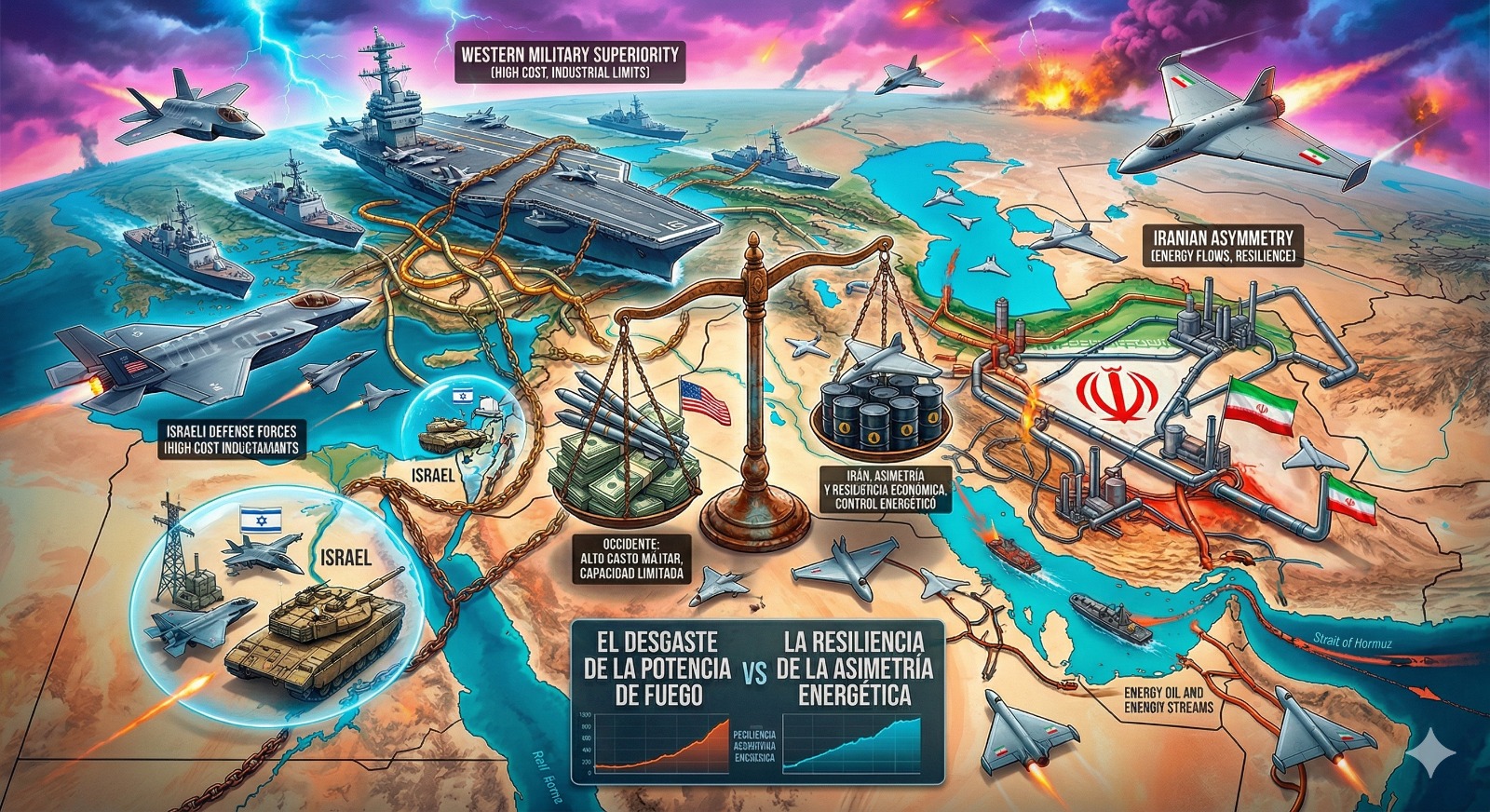
Iran, despite having suffered visible military degradation, has managed to leverage its geography, global economic interdependence, and low-cost asymmetric tools to impose disproportionate costs on its adversaries. Its ability to disrupt global energy flows, combined with its operational resilience, has shifted the strategic balance outside the traditional parameters of power.
At the same time, the United States and Israel face growing constraints: industrial limitations, logistical overstretch, fragmentation of alliances, and the absence of a coherent political objective. These weaknesses are not circumstantial but systemic, reflecting the structural limitations of the Western model of war.
The central conclusion is not that Iran is “winning” in conventional terms, but that the United States and Israel are failing to achieve their strategic objectives. The war is evolving into a prolonged war of attrition, in which economic resilience, political cohesion, and escalation control will determine the outcome.
The illusion of tactical domination
At the beginning of the conflict, the United States and Israel appeared to have established overwhelming tactical superiority. Precision strikes degraded Iran’s visible military assets, reduced the pace of launches, and demonstrated the effectiveness of advanced targeting systems. These results reinforced a familiar assumption: that technological superiority equals control of the battlefield, and that such control can be translated into strategic victory.
However, this perception has proven misleading. The conflict has not remained within the framework of a rapid and decisive war, but has instead evolved into a war of attrition, where sustainability and endurance weigh more heavily than the initial impact.
The transition from shock and awe to attrition reflects a structural shift, in which repeated cycles of attack and counterattack erode capabilities without producing decisive results.
The emergence of supersonic and hypersonic missiles has further weakened the Western advantage. These systems, capable of exceeding Mach 5 and maneuvering in the terminal phase, drastically reduce reaction times and compress interception windows. Even advanced systems such as Patriot or THAAD are facing growing difficulties in responding effectively, especially against saturation attacks and unpredictable trajectories.
At the same time, interceptor depletion and the systematic targeting of radar systems have degraded defensive capabilities. Stockpiles are being consumed faster than they can be replenished, while the destruction of detection infrastructure has reduced tracking capacity, partially blinding defense systems. Combined with the vulnerability of forward bases and naval assets, this shows that tactical superiority is being progressively eroded beneath the surface.
The trap of escalation and strategic drift
The conflict has entered a classic escalation trap, in which initial tactical success generates expectations of rapid victory that fail to materialize. When those expectations collapse, escalation becomes the default response rather than a deliberate strategic decision.
The first phase achieved operational objectives through precision strikes, but it did not produce decisive political effects. The second phase saw Iran expand the conflict horizontally, targeting economic systems and regional infrastructure instead of engaging symmetrically. The third phase, now looming on the horizon, involves pressure toward further escalation, potentially including ground operations. This step would exponentially increase costs and risks without guaranteeing success. Recent history suggests that this trajectory leads to prolonged conflicts rather than decisive victories.
The absence of a clear end state aggravates the problem. Without a defined political objective, escalation becomes an autonomous process. The conflict ceases to be guided by strategy and instead becomes dominated by inertia.
Asymmetric warfare and the redefinition of power
Iran’s strategy is designed to neutralize the advantages of a technologically superior adversary by shifting the conflict into domains where asymmetry prevails. It is based on cost imbalances, economic disruption, geographic advantage, and prolonged endurance. Low-cost offensive systems, such as drones and missiles, impose disproportionate costs on high-value defensive systems. Even limited attacks generate significant economic and psychological effects, forcing the adversary to spend more resources than the attacker invests.
The economic lever amplifies this approach. By targeting energy flows and maritime routes, Iran has shifted the center of gravity of the conflict toward the global economy. Disruption of the Strait of Hormuz affects markets and supply chains on a global scale. Geography and strategic patience consolidate this advantage. Iran’s terrain complicates intervention, while its ability to maintain sustained pressure ensures that even degraded capabilities remain effective. Power is being redefined as the ability to endure and generate cumulative costs.
The Strait of Hormuz and economic warfare
The Strait of Hormuz has become the central strategic axis of the conflict, but its importance must now be understood within a broader network of maritime chokepoints. Iranian authorities have indicated that escalation would not be limited to the Gulf, with the possible activation of allied forces in Yemen capable of attacking the Bab el-Mandeb Strait. This corridor, which connects the Red Sea to the Indian Ocean, represents a second critical artery of world trade. The simultaneous disruption of Hormuz and Bab al-Mandab would endanger a substantial share of global oil and maritime trade, far exceeding the already significant portion associated with the Gulf alone.
This dual pressure transforms the conflict into a systemic economic confrontation. The disruption of Hormuz has already demonstrated the fragility of global supply chains, driving up energy prices and creating ripple effects across fertilizers, food production, and industrial systems. Extending the disruption to Bab al-Mandab would further constrain alternative routes, forcing longer maritime journeys and increasing costs, delays, and risks. The result is a scenario of global economic strain, rather than a contained regional crisis.
In this context, the objective of reopening the Strait of Hormuz by military means appears increasingly unrealistic. U.S. naval assets operate at considerable distances from the Iranian coast, reducing their ability to secure sustained control of the passage. The strait itself is a narrow and highly contested environment, in which Iran has invested for decades in layered defensive systems including mines, missiles, and concealed launch positions. Temporary clearing operations may be possible, but maintaining continuous security would require a level of control that is operationally and politically costly.
These challenges are compounded by the absence of a cohesive international coalition. European allies have been reluctant to participate in direct military operations, and efforts to build a unified response have met resistance. Without broad support, the burden falls disproportionately on the United States, widening the gap between declared objectives and available means. The economic dimension of the conflict has therefore surpassed the capacity of traditional military solutions.
Structural weaknesses of Western strategy
The Western approach to the conflict reflects structural weaknesses that have become apparent over the past decades of military intervention. Resource limitations, particularly the depletion of advanced interception systems, highlight the limits of industrial capacity to sustain a prolonged war of attrition. Modern military systems are complex, costly, and slow to produce, making them poorly suited for prolonged high-intensity conflict.
Historical precedents reinforce this pattern. In Iraq, rapid military victory did not translate into long-term stability, as insurgency and political fragmentation undermined the initial gains. In Afghanistan, two decades of military superiority failed to produce a durable political settlement, culminating in withdrawal without achieving the fundamental objectives. In Libya, airstrikes overthrew the regime but led to sustained instability, while in Syria, external intervention altered the tactical dynamics without securing strategic outcomes aligned with Western goals.
A common feature across all these cases is the disconnect between military action and final political outcomes. Regime change, in particular, has proven difficult to achieve. There is no historical precedent of regime change being accomplished solely through airstrikes without the deployment of ground forces, and even when ground invasions have occurred, the results have rarely matched the initial objectives. This highlights a fundamental limitation of military power in complex political environments.
The current conflict reproduces these structural weaknesses. Reliance on airpower without a viable ground strategy, combined with the weakening of alliance cohesion and the challenges posed by Iran’s geography and scale, reflects a broader pattern of strategic incoherence. Military superiority remains intact, but its translation into lasting results remains uncertain.
Iran’s resilience and consolidation
Iran’s resilience is the result of deliberate long-term preparation rather than reactive adaptation. Over the past twenty-five years, it has developed a “mosaic” defense strategy that decentralizes command and distributes operational capacity across the country. Autonomous units embedded in the provinces can operate independently, reducing reliance on centralized command structures.
This decentralization is supported by institutional redundancy. Leadership structures are designed for rapid replacement, ensuring continuity even in the event of targeted strikes against senior officials. The system anticipates disruption and is structured to absorb it without systemic collapse. Operationally, this translates into a dispersed network of capabilities. Infrastructure is distributed, often concealed or underground, reducing vulnerability to precision strikes. Even when individual nodes are destroyed, the system as a whole remains functional, allowing operations to continue.
The cumulative effect is a high degree of resilience. The strategy is not designed to prevent damage, but to ensure continuity despite it. Combined with greater internal cohesion under external pressure, this creates a system capable of withstanding prolonged conflict and resisting attempts at coercion.
Regional and global repercussions
The conflict is having profound consequences at the regional and global levels, particularly because of disruptions to energy infrastructure. Attacks against key facilities have reduced output and contributed to a sustained rise in global energy prices, with ripple effects across the industrial and agricultural sectors. Regional economies are experiencing growing strain as supply disruptions, rising costs, and declining trade flows become entrenched. Airspace closures and maritime disruptions aggravate these effects, affecting global logistics networks and increasing operational uncertainty for international trade.
The performance of air defense systems has exposed vulnerabilities, especially under sustained pressure from high-speed and maneuverable threats. Shortages of interceptors and the deterioration of radar systems have reduced effectiveness, undermining confidence in the ability to protect critical infrastructure. Perhaps most significantly, trust between Gulf states and the United States is eroding. The presence of U.S. forces is increasingly seen as a source of vulnerability rather than security, prompting regional actors to reassess their strategic alignments. This shift has long-term implications for the geopolitical balance.
The limits of escalation
Escalation has reached a point of diminishing returns, where additional military effort increases costs without delivering proportional strategic benefits. The transition to a war of attrition means that further escalation accelerates resource depletion rather than producing decisive outcomes. Ground operations would face serious logistical and operational challenges, particularly given Iran’s terrain and scale. The resources required would be considerable, and historical precedents suggest that such operations are unlikely to achieve rapid or decisive success.
The economic consequences further constrain escalation. Increased military activity amplifies disruptions in energy markets, contributing to inflation and global instability. These indirect effects undermine broader strategic objectives and create additional pressures on decision-makers. At the same time, de-escalation carries political risks, creating a strategic deadlock. Neither escalation nor withdrawal offers a clear path forward, leaving the conflict trapped within an increasingly narrow set of options.
Redefining victory
Victory in this conflict must be understood beyond traditional military parameters. Strategic objectives such as regime change and deterrence remain unfulfilled, while Iran has maintained stability and expanded its influence in an evolving environment.
Economic resilience has become a determining factor, as the ability to maintain internal stability while imposing external costs is what defines long-term success. The conflict is increasingly unfolding in this domain, rather than solely on the battlefield. Political cohesion and legitimacy determine the ability to withstand prolonged conflict. External pressure often reinforces internal unity, strengthening rather than weakening targeted states and enabling them to sustain resistance.
Control over escalation dynamics and the passage of time have become decisive variables. In a prolonged conflict, endurance and adaptability outweigh immediate battlefield results, redefining the meaning of victory.
The illusion of victory: when power is not enough to win wars
The conflict has demonstrated, with growing clarity, the limits of conventional military superiority in a transformed strategic environment. Tactical dominance has not translated into strategic success, exposing the structural limitations of a model of war that remains optimized for brief and decisive confrontations rather than prolonged and asymmetric conflicts. What is taking place is not a collapse of capability, but a mismatch between means and ends.
Iran is not achieving victory in the conventional sense. It has suffered material losses, the degradation of its assets, and sustained pressure across multiple domains. However, it is successfully reshaping the conflict in ways that favor its structural advantages: resilience, decentralization, and the ability to impose massive systemic costs. The United States and Israel, despite their overwhelming technological superiority, are struggling to convert that superiority into lasting military and political outcomes.
This raises a series of unavoidable and increasingly uncomfortable questions. How can a coalition expect to prevail against a state employing asymmetric warfare when this approach has repeatedly failed against much weaker actors? The United States, even in campaigns strategically aligned with broader regional interests, was unable to achieve decisive victory in Iraq after the 2003 invasion, nor to secure a sustainable strategic outcome in Afghanistan after two decades of intervention (2001–2021).
At the same time, Israel, with structural and multibillion-dollar U.S. military backing sustained for decades, has also failed to achieve conclusive results in its direct confrontation scenarios. Even in recent episodes considered by many Western analysts to be extraordinary successes, the translation into strategic outcomes has been limited. The covert operation against Hezbollah’s logistical networks using electronic devices, including the well-known pager operation, widely described in certain circles as a “strategic miracle,” as well as the killing of Hezbollah Secretary-General Hassan Nasrallah, were interpreted at the time as clear signs that the group had been neutralized. During that period, many experts concluded that the organization had been decisively degraded.
However, the subsequent evolution of the conflict has called those conclusions into question. From February 2026 to the present, Hezbollah has maintained a sustained capacity to launch hundreds of missiles against Israeli territory, while also demonstrating operational resilience on the ground. In direct confrontations, Israeli infantry units have encountered significant resistance in their attempts to advance and consolidate positions in southern Lebanon, showing that the organization retains tactical capability and structural cohesion.
This pattern is not new. In Lebanon, already in 2006, Israel failed to inflict a strategic defeat on Hezbollah despite its military superiority. In Gaza, successive campaigns since 2008 have not eliminated Hamas’s operational capacity. And in Yemen, since 2015, the Houthis have maintained their ability to act despite Western support for regional coalitions. Taken together, these cases reflect a recurring phenomenon: high-impact tactical successes, even those perceived as decisive in the short term, do not necessarily translate into durable strategic results against resilient asymmetric actors.
These cases, different in execution but connected by the same pattern of military superiority confronting asymmetric resistance, are not comparable in scale to Iran. However, they all point to a recurring limit: the inability to translate technological and military advantage into the strategic defeat of decentralized, adaptive adversaries with a high tolerance for attrition. These cases are not anomalies, but part of a broader historical pattern. Since Vietnam, and even in earlier conflicts such as Korea, asymmetric warfare has repeatedly demonstrated that superior firepower does not guarantee victory against an adversary that refuses to fight on conventional terms. If such strategies have failed against non-state actors and fragmented forces, the expectation of success against a large, geographically complex, and strategically prepared state becomes increasingly questionable.
War is no longer defined by victories on the battlefield, but by resilience, sustainability, and systemic influence, and it is in this domain that the true balance of power is decided.
Khalil Sayyad Hilario
Founder & CEO SAHCO Consulting
Madrid, March 24, 2026
Contacter SAHCO
Pour en savoir davantage sur notre expertise et le déroulement de nos missions.


