
'/%3E%3C/svg%3E)
'/%3E%3Cpath%20fill='%23b2b2b2'%20d='M241%20382q0%2016%2017%2026%2017%2011%2042%2011t42-11q16-11%2017-26V269H241'/%3E%3Cpath%20fill='%239f7e00'%20d='M241%20379q0%2014%208%2023%209%209%2021%209%2014%200%2021-9%209-9%209-23V269h-59'/%3E%3Cpath%20d='M241%20339v-70h59v110q0%2014-9%2023l-6%205v-68h-15v72q-8%200-14-4v-68zm59%2040c0%2022%2015%2032%2029%2032%2021%200%2030-18%2030-32v-40h-59'/%3E%3Cpath%20fill='%239f7e00'%20d='M266%20277v5h2v12h-3v-5h2v-5h-9v5h2v5h-4v9h3v18h-5v10h34v-10h-5v-18h3v-9h-4v-5h2v-5h-9v5h2v5h-3v-12h2v-5zm42%20101q0%2010%206%2017%206%206%2015%207%2010-1%2016-7%206-7%206-17v-29h-43'/%3E%3Ccircle%20fill='%230044ad'%20cx='329.5'%20cy='372'%20r='6'/%3E%3Cellipse%20fill='%230044ad'%20cx='300'%20cy='340'%20rx='16'%20ry='21'/%3E%3C/svg%3E)




Beyond static assessments: why continuous monitoring is essential to risk & security management

In an increasingly volatile global environment, risk and security management can no longer rely on static assessments alone. Political instability, security threats, social tensions and rapidly evolving operational contexts can transform risk exposure in a matter of hours.
For organizations operating internationally or in sensitive environments, continuous monitoring has become a strategic necessity. It enables anticipation, early warning and real-time adaptation, all critical to informed decision-making and operational resilience.
Adapting to constantly evolving risk environments
Risk environments are no longer predictable or linear. Security conditions, geopolitical dynamics and local constraints can shift rapidly, sometimes within minutes. In such contexts, periodic assessments quickly become outdated.
Continuous monitoring consists of tracking, analyzing and reassessing risks on an ongoing basis. Rather than relying on fixed review cycles, it allows organizations to maintain situational awareness, adapt operational postures and respond effectively under uncertainty.
This approach is particularly relevant for organizations operating:
- in unstable or conflict-affected regions,
- across multiple countries or jurisdictions,
- in sectors exposed to human, operational or reputational risks.
Why continuous monitoring matters
Continuous monitoring supports decision-making at every level of an organization. It enables a shift from reactive responses to a proactive and adaptive approach to risk management.
Key benefits include:
- early identification of emerging threats and weak signals,
- improved anticipation of crisis scenarios,
- faster and more coordinated responses,
- reduced exposure to operational disruptions,
- enhanced protection of personnel and assets.
Without continuous monitoring, decisions are often based on outdated assumptions, increasing vulnerability during rapidly evolving situations.
From static assessments to dynamic risk intelligence
Traditional risk assessments remain essential, but they must be complemented by real-time intelligence. Continuous monitoring bridges this gap by transforming risk management into a living, adaptive process.
A robust monitoring framework integrates:
- security and geopolitical intelligence,
- operational feedback from the field,
- contextual analysis of local dynamics,
- monitoring of incidents, trends and escalation indicators.
This dynamic approach ensures that risk management remains aligned with reality on the ground rather than theoretical or outdated models. Organizations often establish this foundation through a structured external security assessment before deploying continuous monitoring mechanisms.
A decision-support function
Continuous monitoring is not only about collecting information. Its real value lies in supporting decision-making under pressure.
By consolidating and analyzing data in real time, organizations can:
- adjust travel policies and movement restrictions,
- revise operational plans and contingency measures,
- activate crisis management mechanisms when thresholds are reached,
- communicate timely guidance to exposed teams.
This function is particularly critical for decentralized organizations, where field-level decisions must remain aligned with strategic objectives.
Embedding monitoring into a broader security framework
Continuous monitoring is most effective when integrated into a broader security ecosystem rather than treated as a standalone activity.
A coherent framework combines:
- Audit, to identify vulnerabilities and priority risks,
- Prevention, to reduce exposure through policies and procedures,
- Continuous monitoring, to ensure relevance over time,
- Training, to enable effective interpretation and response.
This integrated approach strengthens organizational resilience in the face of uncertainty and change.
Turning monitoring into action
Continuous monitoring is only effective if teams know how to interpret information and act on it. This requires training that develops situational awareness, decision-making under stress and crisis response capabilities.
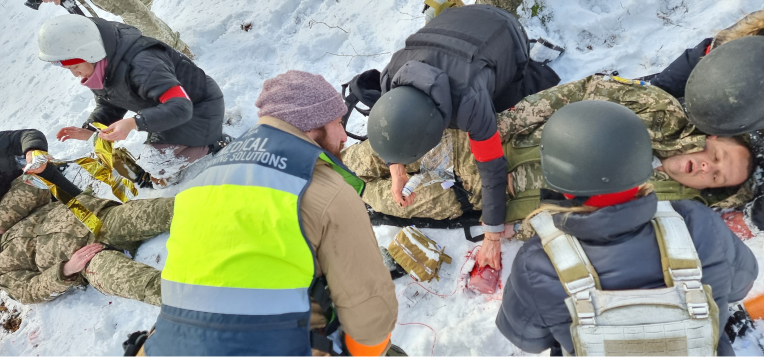
Training programs focused on hostile environments, medical response and operational security play a key role in ensuring that monitoring outputs translate into appropriate actions on the ground.
Applications across sectors
Continuous monitoring supports a wide range of sectors:
- Humanitarian organizations use it to enable safe access and informed engagement with local stakeholders.
- International companies rely on it to support duty of care obligations and ensure business continuity.
- Media organizations and field teams depend on it to anticipate escalation and reduce exposure.
Across sectors, continuous monitoring provides the clarity needed to operate responsibly in uncertain environments.
Working with SAHCO Consulting
Organizations seeking to strengthen their risk and security posture through continuous monitoring benefit from a tailored, operational approach adapted to their specific environments.
Support may include external security audits, strategic and operational advisory services, training programs and crisis preparedness.
To discuss your needs or request tailored support.
FAQ – Continuous monitoring in risk & security management
Why is continuous monitoring necessary if an audit has already been conducted?
Because risk environments evolve constantly. Monitoring ensures that audit findings remain relevant over time.
Is continuous monitoring only useful in high-risk countries?
No. Even low-risk environments can deteriorate rapidly due to political, social or security developments.
Who should be involved in continuous monitoring?
Security managers, operational teams, decision-makers and trained field personnel all play a role.
How often should monitoring outputs be reviewed?
Monitoring should be ongoing, with structured reviews aligned to operational tempo and risk exposure.
Contacter SAHCO
Pour en savoir davantage sur notre expertise et le déroulement de nos missions.


