







TECC Training: Content, Duration, Objectives – Everything You Need to Know

TECC (Tactical Emergency Casualty Care) training addresses a critical need in hostile environments. Designed to prepare humanitarian personnel and first responders for high-risk situations, it is based on medical protocols adapted to tactical contexts. This approach is internationally recognized today and is aimed at professionals exposed to extreme emergencies, particularly in hostile environments.
SAHCO, an expert in post-crisis management, plays a key role in designing and implementing specialized TECC training courses tailored to the real needs of field personnel.
What Is TECC Training?
Definition and Principles of Tactical Emergency Casualty Care
TECC is based on medical care delivered in hostile environments. Priority actions are determined by the level of threat. The goal is to stabilize casualties until definitive medical care is reached. It requires adapting to field constraints while applying validated protocols. Inspired by the military TCCC (Tactical Combat Casualty Care) model, TECC adapts these guidelines for civilian and humanitarian operations, integrating medical skills, logistics, and stress management.
Differences with Other Tactical First Aid Courses
Unlike conventional first aid courses, TECC does not limit itself to basic life-saving techniques. It takes operational dynamics into account. Participants must be able to act under high pressure, often without standard medications or optimal equipment. TECC is designed for individuals who must intervene prior to the arrival of conventional emergency medical services. It requires genuine autonomous decision-making in situations of partial or complete chaos.
Want to understand why NGOs and humanitarian organizations are adopting TECC? Discover why this training is vital for critical missions here.
Main Objectives of TECC Training
Strengthening Response Capabilities in Critical Situations
Equipping humanitarian and operational personnel with skills adapted to field realities is essential. Every second counts. Knowing how to triage, stabilize, and coordinate is crucial. Participants must be able to intervene rapidly without unnecessarily exposing themselves to danger. They must also anticipate medical complications and act decisively even in the absence of specialized healthcare personnel.
Standardizing Emergency Care Protocols
TECC establishes a common operational framework. Every trained individual executes the same life-saving gestures in the exact same sequence. This greatly facilitates multi-agency coordination. TECC protocols aim to eliminate preventable deaths by optimizing each link in the casualty survival chain.
Contact our team of consultants to discuss integrating emergency care protocols tailored to your operational environment.
Pedagogical Content of TECC Training
Theoretical Modules on Medical Care in Hostile Environments
Theoretical modules address the core foundations of medicine in hostile settings, including:
- Immediate recognition and aggressive management of massive hemorrhage.
- Airway assessment and management of critical obstructions.
- Hemorrhage control using appropriate hemostatic and pressure techniques.
- Integrating logistical, physical, and safety constraints into tactical decision-making.
- Tactical communication protocols during crisis events.
- Essential rules to ensure individual and team protection.
These modules provide the essential theoretical foundation required for coherent interventions in volatile environments.
Practical Drills and High-Fidelity Simulations
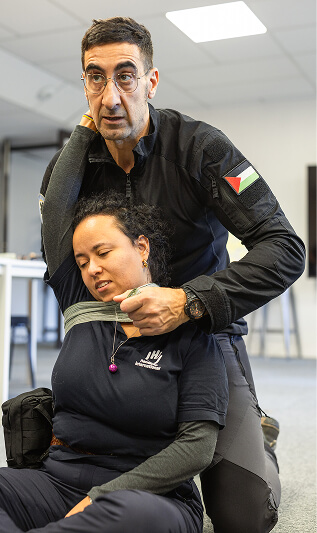
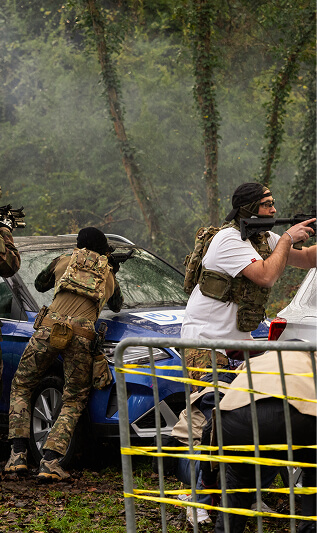
Immersive scenarios put reflexes to the test. Participants must act quickly in simulated high-threat environments. These drills serve to build solid muscle memory and automatic reflexes. Rigorous training is essential to react without hesitation, regardless of the scenario.
To organize a tailored session for your organization, explore our TECC training program.
Duration and Organizational Modalities
Short, Intensive, or Modular Formats
TECC training adapts to organizational constraints and participant requirements through various formats:
- Flexible duration: Courses typically range from 2 to 5 days depending on operational objectives and target proficiency levels.
- Intensive format: A condensed, high-tempo option for rapid and comprehensive skill development.
- Modular sessions: Step-by-step sessions phased over time to enable progressive knowledge retention.
- Adaptability: Modular formatting accommodates demanding operational calendars.
These flexible options allow organizations to choose a delivery model tailored to their specific operational tempo.
Session Organization and Prerequisites
Participants must have sound physical fitness and readiness to operate under stressful, dynamic conditions. Prior medical training is not required. However, candidates with experience in volatile or remote environments often absorb tactical concepts more quickly.
To design a training session aligned with your team’s objectives and schedule, contact our TECC training specialists.
Target Audiences for TECC Training
Security Professionals and Law Enforcement
Security details and law enforcement personnel are frequently the first on scene. They must know how to provide critical interventions before medical responders arrive. TECC delivers concrete tools to maximize casualty survival while preserving tactical security.
Medical Staff and Humanitarian Responders
In conflict zones, medical personnel often operate without external support. Clinical practice must be adapted to acute security constraints. TECC enhances practitioner effectiveness by embedding tactical realities directly into trauma care delivery.
Competency Evaluation and Validation
Theoretical and Practical Assessment Methods
Each participant is evaluated on protocol comprehension and decisive performance during simulated scenarios. Candidates must demonstrate procedural mastery and justify every tactical-medical decision. This rigorous dual evaluation ensures true operational readiness in unstable environments.
International Certification and Recognition
TECC certifications are recognized across numerous countries, international institutions, and non-governmental organizations, granting credentials needed for deployment to high-risk areas.
Sustaining TECC Competencies Over Time
Periodic Refresher Programs
Tactical and medical skills degrade without practice. Protocols evolve and threat environments shift. Periodic refresher sessions are essential to stay aligned with the latest evidence-based guidelines and reinforce decision-making instincts under stress.
Complementary Field Exercises
Knowledge must translate into second-nature reaction. Training under realistic conditions is essential. SAHCO provides tactical review modules and advanced assessments that maintain the long-term physical and mental readiness of operational teams.
To preserve your teams’ TECC competencies over time, explore our continuing training services tailored to your mission requirements.
Conclusion
TECC training has become an indispensable capability for managing tactical emergency casualties. It empowers humanitarian personnel and field operators to act rapidly and methodically in volatile environments. Through scenario-based learning, participants acquire life-saving reflexes and seamless coordination skills. As global crises escalate, investing in validated, internationally recognized training is vital. SAHCO supports institutions and organizations in deploying medical capabilities adapted to their ground reality.
To initiate a partnership or schedule a TECC training program, contact the SAHCO expert team today.
Contact SAHCO
To learn more about our expertise and how our missions are conducted.
Give your career a new boost
Follow theoretical and practical course modules enriched with current field feedback.
Discover our other articles

Strategic and operational field advice

Needs assessment in precarious situations and baseline needs
