







Crisis Communication Course
When a crisis emerges—whether an operational disruption, reputational issue, cyber incident, or external event—there is often a rapid spread of confusion, speculation, and unverified information across media and digital platforms. In today’s interconnected and high-visibility environment, the speed at which information circulates can quickly amplify risks for organisations. At times, the combination of misinformation, intense public scrutiny, and stakeholder concern can escalate the situation beyond the initial incident, directly impacting trust, brand reputation, and business continuity. In such contexts, clear, timely, and credible communication becomes essential to maintaining control of the narrative, supporting decision-making, and protecting the organisation’s integrity.
The role of Crisis Communication in organisational resilience
The Crisis Communication course is a specialised programme designed by SAHCO for professionals operating in corporate and private sector environments, where effective communication is critical to managing crises, protecting brand reputation, and maintaining stakeholder trust.
It is tailored to senior leaders, communication and public relations professionals, risk and compliance teams, and operational managers who may be required to respond to incidents such as reputational threats, operational disruptions, regulatory issues, or public scrutiny involving media, clients, partners, and investors.
In contexts characterised by rapid information flow, high visibility, and significant reputational risk, communication becomes a strategic function—not only for delivering accurate and timely information, but also for shaping narratives, managing stakeholder expectations, and safeguarding the organisation’s credibility and long-term value.

About the
Crisis Communication programme
Effective crisis communication is a critical capability for any organisation, but especially for those operating in volatile, high-risk, or high-visibility environments. During crises—whether operational, reputational, or security-related—organisations must communicate rapidly, accurately, and transparently with multiple stakeholders under conditions of uncertainty and pressure.
Core principles for managing Crisis Communication
Crisis situations often involve incomplete information, reputational risks, and heightened public scrutiny. Teams must balance:
- The need for speed vs. accuracy Transparency vs. confidentiality.
- Operational response vs. public perception
Crisis communication extends beyond issuing statements and includes key operational requirements such as:
- Providing timely and accurate information to internal and external audiences.
- Ensuring stakeholder safety through clear instructions.
- Managing media relations and public narratives.
- Monitoring and responding to misinformation Maintaining organisational credibility and trust
The primary objective is to ensure clear, coordinated, and credible communication that supports operational response, protects stakeholders, and safeguards organisational reputation.
Key benefits by attending our course
Participants will develop key skills to:
- Understand the principles and dynamics of crisis communication
- Strengthen individual communication capabilities under pressure
- Develop organisational crisis communication capacity
- Apply structured tools for planning, response, and recovery
- Manage media relations and public messaging effectively
- Integrate transparency, accuracy, and accountability into crisis response
Target audience
The training is designed for:
- Personnel from non-governmental organisations (NGOs) and humanitarian agencies deployed in field environments.
- Programme managers and project coordinators.
- Security and humanitarian access teams. Journalists and correspondents operating in conflict-affected areas.
- Organisations operating in contexts of restricted access or fragmented territorial control.
This programme is particularly relevant for professionals who engage directly with armed groups or local authorities in sensitive and complex environments.
Methodology and instructors
The programme combines theoretical frameworks with a highly practical approach, based on real-world scenarios. to ensure its direct operational applicability
It is structured around two core components:
Applied theory
Interactive sessions introducing core crisis communication frameworks, including:
- Crisis communication planning and structures Stakeholder mapping and audience prioritisation.
- Communication principles (accuracy, speed, transparency).
- Case study analysis of real crisis events.
Intensive practice
Simulations and exercises replicating crisis environments:
- Crisis response simulations (time-pressured scenarios).
- Media interview role-play.
- Social media crisis management drills.
- Drafting and delivering holding statements
Learning is reinforced through:
- Structured feedback from instructors.
- Peer-to-peer learning and experience sharing.
- Gradual introduction of complexity and uncertainty
Training is delivered by professionals with direct experience in crisis communication, corporate media management, and emergency response.



What will you learn from the Crisis Communication training?
This training is based on realistic scenarios that enable participants to develop practical skills to ensure their own safety and that of their team whilst on the move.






Fundamentals of Crisis Communication
- Definition and characteristics of a crisis
- Core objectives of crisis communication
- Principles: accuracy, speed, consistency, transparency
- The crisis communication lifecycle (preparedness → response → recovery)
- Roles and responsibilities within a Crisis Response Team (CRT)
Crisis Communication planning and preparation
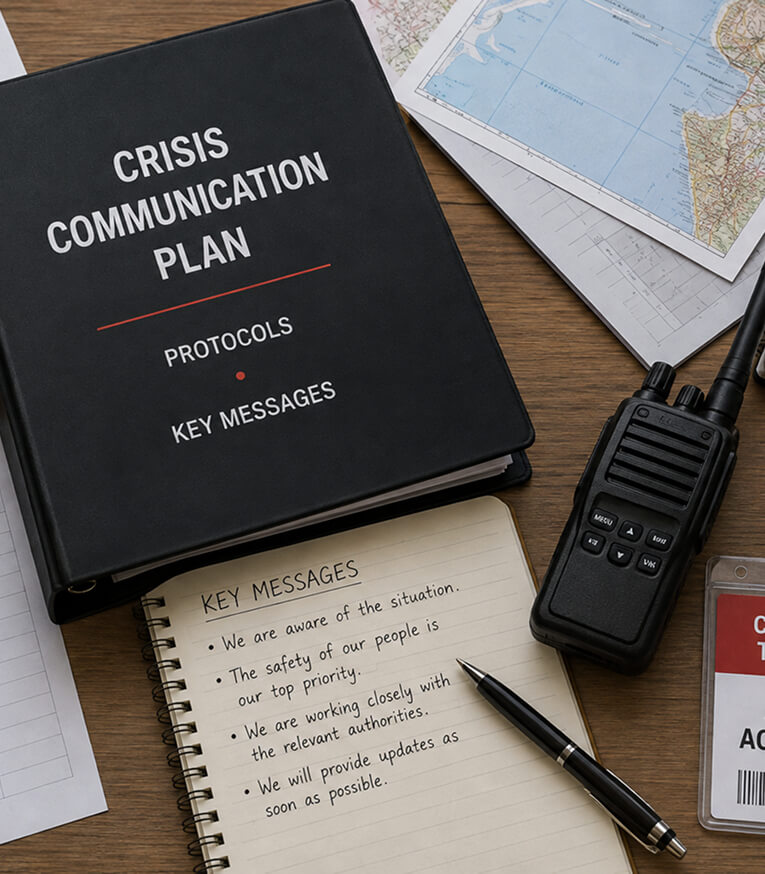
- Developing a crisis communication plan
- Identifying crisis scenarios (e.g., security, reputational, operational)
- Preparing holding statements and message templates
- Defining communication channels and protocols
- Establishing crisis command structures and communication flows
- Pre-identify spokespersons
- Ensure coordination across teams
Stakeholder and audience analysis
Identification of key audiences (internal and external):
- Employees
- Media
- Authorities
- Partners
- General public
Messaging, media, and information management
- Crafting clear, concise, and consistent messages
- Developing holding statements and updates
- Media engagement strategies and interview techniques
- Managing misinformation and rumours
- Ensuring message approval and coordination
Crisis response and real-time communication
- Activation of crisis communication protocols
- First 1–2 hours response actions (critical timeline)
- Internal coordination and information flow
- Deployment of initial holding statements
- Continuous monitoring and message adaptation
Post-crisis communication and evaluation
- Conducting post-crisis evaluations
- Assessing communication effectiveness
- Identifying lessons learned
- Updating crisis communication plans
- Supporting organisational recovery and reputation rebuilding
- Introduction to CSR and ESG principles
Our certificates
Our methodology integrates multi-source intelligence, scenario modelling, and forward-looking analysis to identify emerging threats and opportunities.




Movement

Control
Resilience
Control
The question is not if a crisis hits, but when. Ensure your team is crisis-ready
Do not wait for an incident to strike to put your communication to the test. Equip your leaders to safeguard your organisation’s credibility through structured tools and expert training.
Social media and digital communication