







How to Effectively Test and Update a Contingency Plan
A well-designed contingency plan is not enough. It must be tested, adjusted, and updated regularly. This process ensures operational resilience in the face of any type of crisis. It helps prevent critical disruptions and improves decision-making during emergencies…
How to Develop Standard Operating Procedures and Implement a Robust Security Policy
In a world where risks are increasingly numerous and complex, it has become crucial for organizations to develop Standard Operating Procedures (SOPs) and implement a robust security policy. This approach not only ensures the safety of humanitarian staff and infrastructure but also guarantees organizational sustainability in the face of both external and internal threats…
Essential Preparedness for High-Risk Humanitarian Negotiations
Articles Essential Preparedness for High-Risk Humanitarian Negotiations Discover our training courses Humanitarian negotiations require rigor and method. In unstable environments, every mistake can cost lives. Actors must act with caution, anticipate risks, and rely on solid preparation. Nothing should be left to chance, as improvisation can jeopardize an entire mission. This article outlines the essential […]
Defensive Driving: What Makes It Different from Regular Driving?
Articles Defensive Driving: What Makes It Different from Regular Driving? Discover our training courses Road safety does not rely solely on following traffic regulations. It also depends on the driver’s behavior and ability to anticipate danger. This is where defensive driving comes in—an approach that prioritizes risk prevention rather than simple reaction. Unlike traditional driving, […]
From Contextual and Geopolitical Analysis toOperational Action: Structuring Your Securityand Geopolitical Risk Management
Facing global instability, anticipating threats is essential to protecting staff, infrastructure, and
critical processes. Geopolitical risks can disrupt operations and supply chains, making
reactive approaches insufficient…
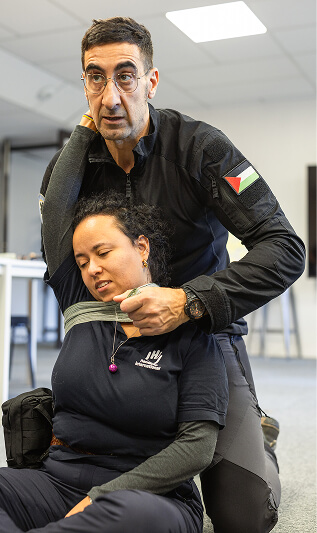
TECC Training: learning the emergency medical reflexes to manage severe injuries in isolated and/or hostile environments.
Responding to severe injuries in unstable environments demands composure, speed, and
technical skill. Hostile settings can turn a routine mission into a critical emergency. In these
situations, TECC training (Tactical Emergency Casualty Care) provides teams with the
specialized medical reflexes needed for extreme emergencies…
TECC Training: Mastering Emergency MedicalReflexes for Severe Injuries in Remote and/or Hostile Environments
Responding to severe injuries in unstable environments demands composure, speed, and
technical skill. Hostile settings can turn a routine mission into a critical emergency. In these
situations, TECC training (Tactical Emergency Casualty Care) provides teams with the
specialized medical reflexes needed for extreme emergencies…
Security Compliance Audit in High-RiskAreas: Methodology, Limitations and KeyLevers
High-risk areas combine political, economic, and security instabilities that can threaten civil
society organisations and/or private companies. In these fragile environments, every
decision must be measured and anticipated. A security compliance audit is a central tool for
detecting vulnerabilities and ensuring business and operational continuity…
Contingency plan vs. emergency plan: what are the differences and how can they be combined?
In the humanitarian sector, anticipating and reacting effectively to crises is an absolute necessity to guarantee the safety of humanitarian teams and the continuity of missions in the field. In this respect, two types of strategy are frequently mentioned: contingency planning and emergency planning.
Implementing an effective preventive security strategy: where to start?
Humanitarian actors often operate in unstable contexts, where security threats can hamper their missions and endanger their teams. To minimize these risks, it is essential to put in place a solid preventive security strategy adapted to each operational context…